Sustainability remains integral Sibanye-Stillwater strategy, long-term value creator


Sibanye-Stillwater chairperson Dr Vincent Maphai and CEO Dr Richard Stewart.
South Africa's platinum group metals, gold and uranium.
2025 Report Suite graphic.




JOHANNESBURG (miningweekly.com) – The embedding of sustainability remains integral to the strategy and long-term value creation of JSE-listed Sibanye-Stillwater, which records progress across energy, water and social outcomes in its 'Report Suite 2025', just out.
The suite of reports and supplements, which provide detailed insight into various operational, financial and strategic initiatives, are designed to keep stakeholders informed and engaged with progress and future plans.
Encompassing data pertaining to January 1 to December 31, 2025, the suite outlines ongoing commitment to resource stewardship that complements primary mining by advancing circular economy solutions through recycling operations and metals production through secondary mining activities.
The green metals and gold mining company headed by chairperson Dr Vincent Maphai and CEO Dr Richard Stewart, tells of these efforts strengthening environmental performance, long-term cost competitiveness and operational resilience.
With 765 MW of renewable energy contracted, energy cost savings of R1-billion-plua a year are expected to be delivered from 2028 onward, with average electricity costs 20% to 30% lower than the forecast wholesale Eskom tariffs at commercial steady state.
From 2028, this energy transition is expected to reduce greenhouse-gas emissions by 2.63-million tonnes of carbon dioxide equivalent a year, representing 41% of total emissions.
Operated are six dedicated water treatment plants capable of producing 37-million litres a day of potable water – sufficient for 130 000 people daily.
South Africa gold operations (SA Gold) have achieved water independence of 94% and water-related savings of R260-million have been realised.
Operations that form part of South African platinum group metals (SA PGM) have 13 wastewater treatment plants that recycle some 90% of effluent for operational use.
Since 2024, dependence on Rand Water has been systematically reduced by 40% and overall water independence of 90% by 2028 is planned.
The Sibanye-Stillwater Foundation Commitment to social stewardship received R55.6-million in March 2026 and housing for the Marikana widows has been completed.
Socioeconomic resilience has been strengthened by R453-million being donated to community and employee ownership trusts and a three-year wage agreement being concluded without labour disruption.
Collaboration with host communities is continuing to support sustainable livelihoods and long-term post-mining economic opportunities. In South Africa, 21.5% of procurement (R6.4-billion) is spent on local suppliers, which has a 260 000-plus job impact.
RAPIDLY CHANGING WORLD
Sibanye-Stillwater’s Report Suite 2025 observes that where and how capital is sourced, the manner in which supply chains are structured and where metals are produced, refined and consumed, is being influenced by an increasingly complex, volatile, global environment, which is being shaped by geopolitical fragmentation, conflicts, shifting economic power and rapid technological change, as well as more multipolarity.
At the same time, commodities and critical minerals' long-term structural demand drivers are being reshaped by a growing global middle-class, rising energy demand, evolving regulation and accelerating technological innovation.
Together, these forces are redefining value chains, elevating the strategic importance of beneficiation and increasing the volatility and pace of change that mining companies must navigate.
Commodity price swings have been at record levels. Gold reached an all-time high spot price of $5 595/ oz in late January this year and the substantial price gains of platinum, palladium and rhodium have arisen amid heightened uncertainty and constrained supply.
Regulatory restrictions, restocking, and supply tightness resulted in fourth-quarter 2025 lithium prices rebounding sharply.
With supportive commodity prices, disciplined capital allocation, and improving operational stability, Sibanye-Stillwater anticipates continued earnings growth and balance sheet resilience.
The repositioning of operations over the past few years has resulted in greater operational stability and overall improved performance.
Resilience and effective cost control has delivered significant financial commodity price leverage.
PRODUCTION AMID HIGHER PRICES
The SA PGM operations produced nearly 1.8-million four-element (4E) ounces, including attributable volumes and purchased concentrate, in line with guidance. This was achieved despite a 29% decline in surface production, mainly the result of heavy rainfall and a tailings storage transitioning.
All-in sustaining cost rose 10% to R24 193 per four-element ounce ($1 353/4Eoz) on higher PGM-price-linked royalty payments and increased sustaining capital.
Increased second-half PGM prices drove a 125% increase to R16.7-billion of 2025 earnings before taxation depreciation and amortisation (Ebitda).
The operational challenges at the Kloof mine impacted the 2025 performance of South African gold operations, with seismicity and infrastructure constraints leading to the cessation of mining in certain high-risk areas for safety reasons.
The revised mine planning includes the deliberate exclusion of high-grade isolated high-risk mining areas and conforms with Sibanye-Stillwater’s commitment to safe and sustainable mining practices.
While SA Gold’s 10% production decline to 19 668 kg (632 341oz) included surface mining company DRDGOLD, the operations remain highly leveraged to the gold price. The 39% year-on-year gold-price increase more than compensated for the 14% reduction in gold sold, driving a 114% 2025 Ebitda increase to R12.5-billion.
RESOURCES AND RESERVES
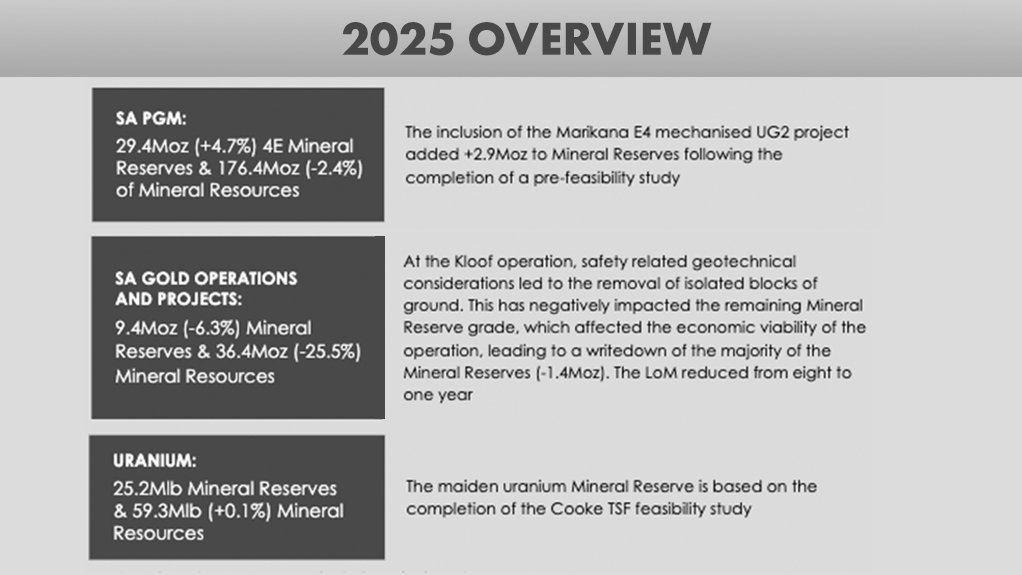
The mineral reserves of SA PGM increased by 4.7% through the Marikana E4 upper group two mechanised project, adding 2.9-million ounces on completion of a prefeasibility study.
SA Gold mineral resource and reserves were impacted by the exclusion of 1.4-million reserve ounces at Kloof.
Exploration at the Keliber lithium project, in Finland, resulted in a 40 000 t mineral resource increase.
The completion of a feasibility study for the Mt Lyell copper project, in Australia, resulted in a copper reserve of 478 000 t and a uranium oxide mineral reserve of 25.2-million pounds was declared following the completion of the tailings feasibility study at Cooke, on South Africa’s West Rand.
Realised in 2025 in North Amerivca were the benefits of the restructuring of the US PGM operations in the last quarter of 2024.
Production of 284 069 oz exceeded annual guidance, with AISC of $1 203/oz below guidance. This operational performance, combined with higher average PGM basket prices, enabled the US PGM underground operations to return to profitability, reporting adjusted Ebitda of $249-million (R4.4-billion).
With tax credits, the recycling operations contributed adjusted Ebitda of $228-million (R4.1-billion) for the year.
The Century zinc tailings retreatment operation, in Australia, beat production and cost guidance, with payable zinc production increasing 22% to 101 000 t and AISC improved 17% to $1 921/t (R34 356/t). This drove adjusted Ebitda to $88-million (R1.6-billion), supported by production stability, firmer zinc prices and lower treatment charges.
Article Enquiry
Email Article
Save Article
Feedback
To advertise email advertising@creamermedia.co.za or click here
Research Reports

Projects
Latest Multimedia
Latest News
Showroom
ZF Aftermarket is the after-sales division of the world-renowned German ZF group, a global leader in mobility technology.
VISIT SHOWROOM
Columbus Stainless, based in Middelburg, Mpumalanga, is Africa’s only producer of stainless steel flat products. In addition, Columbus is the only...
VISIT SHOWROOM
Announcements
What's On
Subscribe to improve your user experience...
Option 1 (equivalent of R125 a month):
Receive a weekly copy of Creamer Media's Engineering News & Mining Weekly magazine
(print copy for those in South Africa and e-magazine for those outside of South Africa)
Receive daily email newsletters
Access to full search results
Access archive of magazine back copies
Access to Projects in Progress
Access to ONE Research Report of your choice in PDF format
Option 2 (equivalent of R375 a month):
All benefits from Option 1
PLUS
Access to Creamer Media's Research Channel Africa for ALL Research Reports, in PDF format, on various industrial and mining sectors
including Electricity; Water; Energy Transition; Hydrogen; Roads, Rail and Ports; Coal; Gold; Platinum; Battery Metals; etc.
Already a subscriber?
Forgotten your password?
Receive weekly copy of Creamer Media's Engineering News & Mining Weekly magazine (print copy for those in South Africa and e-magazine for those outside of South Africa)
➕
Recieve daily email newsletters
➕
Access to full search results
➕
Access archive of magazine back copies
➕
Access to Projects in Progress
➕
Access to ONE Research Report of your choice in PDF format
RESEARCH CHANNEL AFRICA
R4500 (equivalent of R375 a month)
SUBSCRIBEAll benefits from Option 1
➕
Access to Creamer Media's Research Channel Africa for ALL Research Reports on various industrial and mining sectors, in PDF format, including on:
Electricity
➕
Water
➕
Energy Transition
➕
Hydrogen
➕
Roads, Rail and Ports
➕
Coal
➕
Gold
➕
Platinum
➕
Battery Metals
➕
etc.
Receive all benefits from Option 1 or Option 2 delivered to numerous people at your company
➕
Multiple User names and Passwords for simultaneous log-ins
➕
Intranet integration access to all in your organisation