Sasol optimistic of market demand for Natref’s premium SAF and renewable diesel

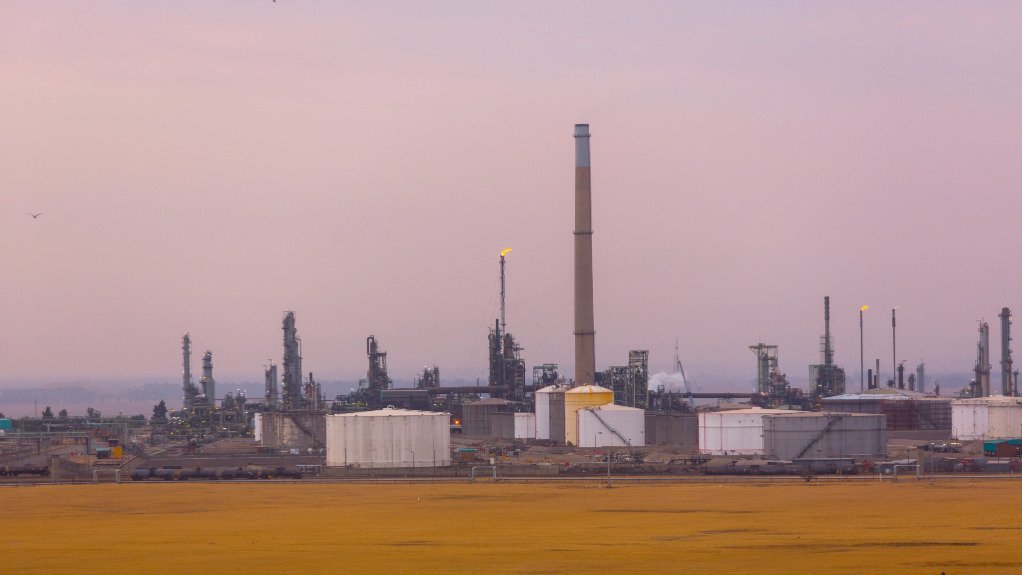



Energy and chemicals group Sasol, which recently secured product-sustainability certification for jet fuel and diesel produced from used cooking oil and vegetable oils at its Natref refinery, says any potential ramp-up to 200-million litres, or beyond, will now depend on market demand.
Business building, strategy and technology executive VP Sarushen Pillay tells Engineering News that an onsite audit by TÜV SÜD confirmed that Natref is able to produce products classifiable as a sustainable aviation fuel (SAF) and renewable diesel in line with International Sustainability and Carbon Certification, or ISCC+.
These certified fuels, which trade at a premium relative to traditional jet fuel and diesel, will be marketed to airliners facing tightening sustainable-fuel mandates, as well as mining, logistics and corporate entities seeking to reduce their carbon footprints.
“The concept now is to sell the SAF produced at Natref to global airliners that are seeking to claim carbon credits, and which refuel at the OR Tambo International Airport,” Pillay says.
He is also optimistic that its ‘drop-in’ renewable diesel could prove attractive to mining and other entities looking for new avenues to accelerate their decarbonisation over-and-above their ongoing transition to renewable electricity so as to reduce the exposure of their exports to carbon border levies.
The refinery in South Africa's Free State province has a nameplate capacity of 108 000 bl/d and Pillay says that, with no or low capital investment, up to 15% of that capacity could be deployed in future to produce hydroprocessed esters and fatty acids, or HEFA, fuels.
However, the initial ramp-up will be modest, with about two-million litres this year, 16-million litres next year and with the far higher production target planned for the end of the decade.
Asset transformation VP Vimal Bhimsan reports that the certification process confirmed the greenhouse-gas (GHG) intensity of SAF produced with used cooking oil to be 22 gCO2eq/MJ, more than 75% lower than the 94 gCO2eq/MJ associated with jet fuel from crude.
It also showed the GHG intensity of renewable diesel derived from used cooking oil to be 23 gCO2eq/MJ, compared with 94 gCO2eq/MJ for diesel derived from crude.
Bhimsan stresses that the certification also involves the measurement of the full value chain, including water use to grow the crops that may be employed in future, such as potentially using vegetable oil derived from Solaris and Moringa crops.
Sasol, Anglo American and De Beers are piloting the production of vegetable oils from Solaris and Moringa plantations on degraded mining land, while also using treated acid mine drainage.
The immediate focus at Natref, however, is on securing used cooking oil that is already being collected and aggregated domestically, but which is mostly being exported to Europe for reprocessing.
CHEMICALS CERTIFICATION
In addition, certain chemicals produced at Secunda using bioethanol as an input have also been certified, notably monomers that are used in downstream chemical products such as plastics, acrylates and solvents.
Sasol, which is looking to reduce Secunda’s massive carbon footprint, believes there is potential to source far more bioethanol from the South African sugar industry, which is in search of new sources of demand to provide a lifeline to a sector that is in distress.
Bhimsan acknowledges, though, that this will require a coordinated national effort to facilitate the investments that will be needed to upscale production.
Meanwhile, Sasol is also assessing the potential to buy some of the wood chips currently being exported through Richards Bay for use in its Secunda gasifiers to produce lower-carbon chemicals.
The JSE-listed group is also participating in the Hyshift Consortium that is aiming to produce SAF using green hydrogen in its existing Fischer-Tropsch reactors.
However, producing such power-to-liquid fuels as Secunda would not currently meet Europe’s Renewable Fuels of Non-Biological Origin compliance criteria.
These involve strict additionality and temporal matching rules for renewables generation and hydrogen production, which means that any green-hydrogen-derived SAF currently produced at Secunda cannot currently access the EU’s market that makes a minimum SAF blend mandatory. There are ongoing discussions between South Africa and the EU on integrating a flexible-allocation methodology in future, however.
Pillay indicates that the initiatives at both Natref and Secunda form part of a broader strategy to leverage existing assets as a springboard into future low-carbon markets, and rebuffs claims of possible ‘greenwashing’.
He argues that the certification process proves the fuel’s sustainability advantages over the traditional crude route, while highlighting the social, employment and community benefits associated with employing and/or repurposing existing assets.
“This project achieves all of that while also giving you a near 80% emission reduction. So, I believe it ticks all the boxes of a sustainable product,” he states.
Article Enquiry
Email Article
Save Article
Feedback
To advertise email advertising@creamermedia.co.za or click here
Research Reports


Projects
Latest Multimedia


Latest News


Showroom

North Ridge Pumps is an independent manufacturer of pumps. We have a proven track record for product support and customer service throughout the...
VISIT SHOWROOM
As a reticulator, Egoli Gas provides natural gas to homes and businesses via underground pipes.
VISIT SHOWROOM


Announcements
What's On
Subscribe to improve your user experience...
Option 1 (equivalent of R125 a month):
Receive a weekly copy of Creamer Media's Engineering News & Mining Weekly magazine
(print copy for those in South Africa and e-magazine for those outside of South Africa)
Receive daily email newsletters
Access to full search results
Access archive of magazine back copies
Access to Projects in Progress
Access to ONE Research Report of your choice in PDF format
Option 2 (equivalent of R375 a month):
All benefits from Option 1
PLUS
Access to Creamer Media's Research Channel Africa for ALL Research Reports, in PDF format, on various industrial and mining sectors
including Electricity; Water; Energy Transition; Hydrogen; Roads, Rail and Ports; Coal; Gold; Platinum; Battery Metals; etc.
Already a subscriber?
Forgotten your password?
Receive weekly copy of Creamer Media's Engineering News & Mining Weekly magazine (print copy for those in South Africa and e-magazine for those outside of South Africa)
➕
Recieve daily email newsletters
➕
Access to full search results
➕
Access archive of magazine back copies
➕
Access to Projects in Progress
➕
Access to ONE Research Report of your choice in PDF format
RESEARCH CHANNEL AFRICA
R4500 (equivalent of R375 a month)
SUBSCRIBEAll benefits from Option 1
➕
Access to Creamer Media's Research Channel Africa for ALL Research Reports on various industrial and mining sectors, in PDF format, including on:
Electricity
➕
Water
➕
Energy Transition
➕
Hydrogen
➕
Roads, Rail and Ports
➕
Coal
➕
Gold
➕
Platinum
➕
Battery Metals
➕
etc.
Receive all benefits from Option 1 or Option 2 delivered to numerous people at your company
➕
Multiple User names and Passwords for simultaneous log-ins
➕
Intranet integration access to all in your organisation