SA does not lack plans, but delivery systems, CESA Indaba hears


Acting Director General of the Department of Electricity and Energy, Subesh Pillay on Wednesday said that, “South Africa does not lack plans or budget allocations [for delivering on its infrastructure projects], but lacks a delivery system capable of consistently converting these into completed and functioning infrastructure assets”.
Speaking during the Consulting Engineers South Africa (CESA) Infrastructure Indaba 2026, held in Durban, Pillay noted that, “Despite significant public infrastructure allocations over the medium-term, underspending and delays persist across national departments, state-owned entities and municipalities.”
“Infrastructure performance is not merely lagging; it is structurally constrained. Gross fixed capital formation contracted in 2025, construction output declined, and the pipeline of projects entering the system has weakened,” he noted during his keynote speech at the Infrastructure Indaba, which was held under the theme "Pioneering Change: Engineering Infrastructure for Inclusive Growth.”
This systemic delivery gap was starkly quantified by the Auditor General of South Africa’s Deputy Business Unit Leader National Tintswalo Masia, who revealed 292 material irregularities in national and provincial government for 2023-24.
These irregularities stemmed from non-compliance, suspected fraud, and issues like payments for undelivered goods/services, unfair procurement, lost value for money, unrecovered revenue, late payment penalties, and wasteful spending, resulting in R14.3-billion in losses. Local government logged 446 irregularities, causing R8.47 billion in damage.
Positively, she noted that recovery efforts have yielded R1.3 billion overall (R709.26 million recouped, R244.12 million prevented, R370.24 million pending), highlighting procurement reforms' potential to turn underspending into assets.
Meanwhile, infrastructure expansion, Pillay argued, requires a fundamental reconfiguration of resources, rebuilding an ecosystem of skilled engineers and investments in project preparation capacity, amid global supply chain pressures and long lead times for specialised equipment. He highlighted that projects that form part of the Integrated Resource Plan (IRP 2025) alone would require an estimated generation investment pipeline in the order of R2 trillion to R3 trillion, which required careful planning and allocation.
“Engineers [play a] central role in project preparation, procurement and asset management, [and we need] joint accountability between government and the profession to shift from planning to execution,” he stated.
This sentiment was expressed by CESA President, Dr. Vishal Haripersad, where he urged early integration of engineers into decision-making processed. “Pioneering change requires that engineering insight helps shape strategies, budgets and national priorities.”
When engineering expertise informs decisions early, infrastructure performs better, lasts longer, and delivers greater value to society,” he stated.
During Haripersad’s opening address, he emphasised that when engineering expertise informs decisions early, infrastructure performs better, lasts longer, and delivers greater value to society.
“Infrastructure represents public trust made concrete. When governance fails, when quality is compromised, or when corruption takes root, the consequences are felt not in reports or balance sheets, but in communities and livelihoods. This is why transparency, professional standards, and ethical leadership remain essential to building infrastructure that serves the public good,” Haripersad stated.
Highlighting the engineering shortage of 60,000 professionals in the engineering industry, Haripersad’s sentiments were echoed in other sessions that amplified these themes. His focus on the development of young professionals and a call for mentorship and investment, was also echoed in the "Transformation: Advancing an Inclusive Engineering Profession through BBBEE, Employment Equity Targets, and Diversity Initiatives," session, which was facilitated by Sechaba Kou of Isao Consulting.
Jabulile Msiza, CESA Vice-President and Director at Jones & Wagener, pinpointed mid-career progression bottlenecks in mentoring, registration and retention, noting that consulting engineering firms likely in some cases advance juniors but stall at senior targets.
Many engineers in this timeframe, she noted, have often moved into other sectors or found employment in overseas companies, which further constrained the skills development pipeline in the country.
Ntsoaki Mamashela from the Department of Employment and Labour clarified that sectoral employment equity targets are flexible guidelines, not quotas, to diversify senior levels and seize opportunities, while Sekadi Phayane-Shakhane, SAICE CEO, highlighted low female representation despite 65% youth membership, motivating for intentional inclusion, mentorship, and professionalisation as infrastructure success pillars.
Capacity Building Imperatives
The "Capacity Building: Engineering Professional Excellence Across Public & Private Sectors" session, led by Tshidi Mndzebele of Avenir Group and CESA Gauteng Branch Chair, further tackled the nexus between the skills gaps and municipal readiness.
Mapatane Kgomo, Municipal Infrastructure Support Agent (MISA) CEO, warned that poor maintenance would further erode service quality, reliability and jobs, advocating proactive engineer involvement from conceptualisation. Meanwhile, Paul Mzimande of iX Engineers highlighted that project structures sidelined mid-tier firms, fostering brain drain and cut-throat, margin-eroding competition. “Don’t put your brightest people right at the end of the process, we need to be part of projects from the start,” he warned.
Also speaking as part of the session, Uzair Osman of Bosch Projects and former CESA YPF Chair addressed the impact of late payments in the industry, providing insights from surveys held with member companies and its negative consequential impact on consulting engineering companies and the affordability to employ graduate engineers that require further investment to convert newly gained knowledge into skills. This is true of the medical, legal and accounting professions and is no different for engineerineering.
During the last session, "Engineering, Procurement, and Infrastructure Strategies and delivery models," facilitated by Logashri Sewnarain, CEO of SMEC South Africa, and a CESA Board Member, speakers including Dominic Collett, the office manager for eThekwini and Zutari Technical Director for Land Infrastructure; George Kanyika, KZN Provincial Treasury Chief Director for Infrastructure Management and Economic Services; Veer Ramnarain, the President of the South African Institute of Electrical Engineers and Themba Mdletshe, a representative of the National Treasury Public-Private Partnership Unit, shared their insights on how infrastructure ecosystem role players could activate an accountability ecosystem to address the root causes of poor institutional integrity, a lack of accountability and consequence management.
CESA CEO Chris Campbell concluded the first day of the event highlighting that the country’s infrastructure sector required bold thinking, strong collaboration and capable institutions to unlock the full potential of infrastructure as a catalyst for economic growth, job creation and social development.
“The conversations held today speaks directly to the role that engineering leadership, policy direction and collaboration must play in shaping infrastructure that supports sustainable economic growth and meaningful development across South Africa.”
Article Enquiry
Email Article
Save Article
Feedback
To advertise email advertising@creamermedia.co.za or click here
Research Reports

Projects

Latest Multimedia

Latest News

Showroom

Columbus Stainless, based in Middelburg, Mpumalanga, is Africa’s only producer of stainless steel flat products. In addition, Columbus is the only...
VISIT SHOWROOM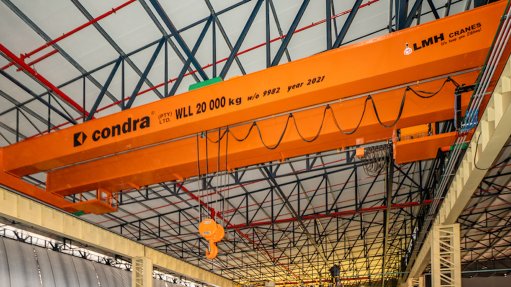
ISO-certified Condra manufactures overhead cranes, portal cranes, cantilever cranes and crane components: hoists, drives, end-carriages, brakes and...
VISIT SHOWROOM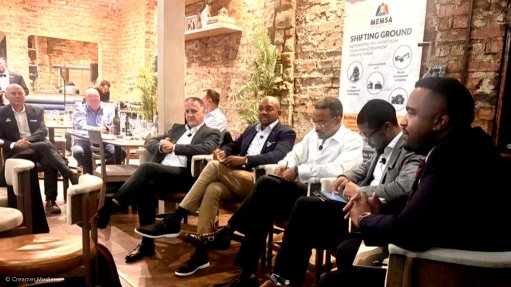
Announcements
What's On
Subscribe to improve your user experience...
Option 1 (equivalent of R125 a month):
Receive a weekly copy of Creamer Media's Engineering News & Mining Weekly magazine
(print copy for those in South Africa and e-magazine for those outside of South Africa)
Receive daily email newsletters
Access to full search results
Access archive of magazine back copies
Access to Projects in Progress
Access to ONE Research Report of your choice in PDF format
Option 2 (equivalent of R375 a month):
All benefits from Option 1
PLUS
Access to Creamer Media's Research Channel Africa for ALL Research Reports, in PDF format, on various industrial and mining sectors
including Electricity; Water; Energy Transition; Hydrogen; Roads, Rail and Ports; Coal; Gold; Platinum; Battery Metals; etc.
Already a subscriber?
Forgotten your password?
Receive weekly copy of Creamer Media's Engineering News & Mining Weekly magazine (print copy for those in South Africa and e-magazine for those outside of South Africa)
➕
Recieve daily email newsletters
➕
Access to full search results
➕
Access archive of magazine back copies
➕
Access to Projects in Progress
➕
Access to ONE Research Report of your choice in PDF format
RESEARCH CHANNEL AFRICA
R4500 (equivalent of R375 a month)
SUBSCRIBEAll benefits from Option 1
➕
Access to Creamer Media's Research Channel Africa for ALL Research Reports on various industrial and mining sectors, in PDF format, including on:
Electricity
➕
Water
➕
Energy Transition
➕
Hydrogen
➕
Roads, Rail and Ports
➕
Coal
➕
Gold
➕
Platinum
➕
Battery Metals
➕
etc.
Receive all benefits from Option 1 or Option 2 delivered to numerous people at your company
➕
Multiple User names and Passwords for simultaneous log-ins
➕
Intranet integration access to all in your organisation