S Africa-based company expands global presence in defence sector

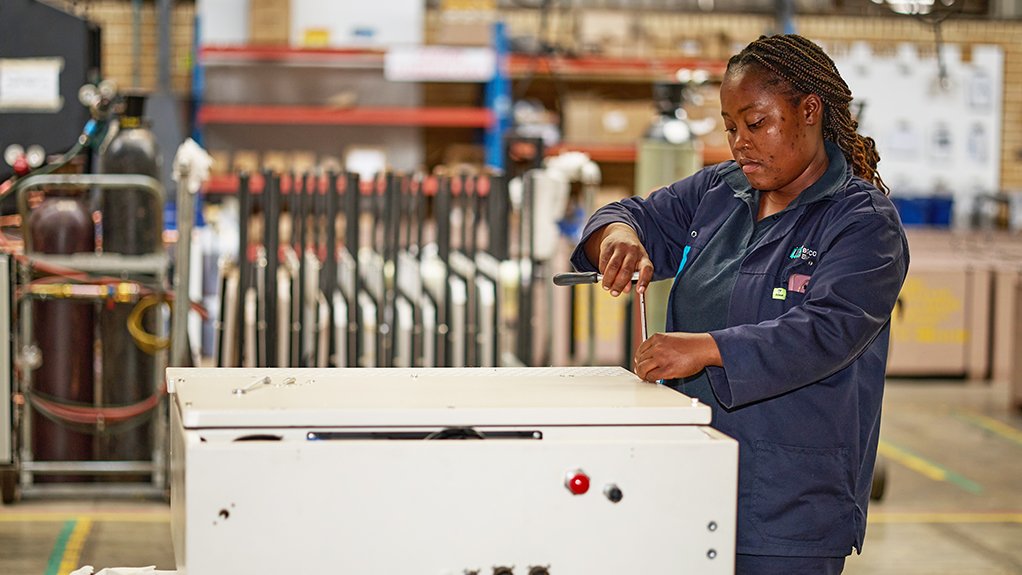



South Africa-based Booyco Engineering is supplying specialised heating, ventilation and air conditioning (HVAC) systems to global defence-industry customers.
The company’s recent projects include the design and manufacture of cooling systems for radar jamming shelters as well as for military amphibious vehicles.
“We engineer our systems to suit the particular demands of complicated military equipment, designed for the harshest conditions while still meeting onerous specifications,” says Booyco Engineering executive director Grant Miller.
The company highlights a recent project in which its custom-engineered solutions are being fitted to specialised hard-skinned radar jamming shelters - manufactured in South Africa by ADG Mobility for export. Built on an ISO-container footprint, the shelters house sensitive electronic systems, radar-interference technology and ballistic protection rated to withstand light arms fire.
“This environment creates severe thermal and electromagnetic demands,” explains Miller. “Not only must the HVAC system maintain stable internal temperatures for both personnel and electronics, but it must do so while complying with rigorous electromagnetic interference standards.”
Booyco Engineering says it designed the system in accordance with US military standards 461F, which governs electromagnetic interference in military environments, in order to meet the demanding electromagnetic compatibility requirements.
“When you are dealing with radar-related systems even small emissions can compromise performance - so the HVAC unit itself must be part of the protection strategy,” he says. “Acoustic considerations are also important, to ensure a quiet working environment; our system therefore operates at around 50 dB, significantly quieter than a typical office unit.”
To meet the extreme thermal specifications imposed by the shelters, the HVAC system is engineered for operating temperatures from -40 °C to 55 °C, with a maximum cooling output of 9 kW and heating of approximately 6.5 kW. The HVAC design must also be able to accommodate the shock and vibration demands of mobile military platforms, aligning with both MIL-STD-810G and the AECTP-400 requirements for mechanical stresses.
“These shelters are mounted on military trucks that move over rough terrain, so the system must endure the same treatment,” Miller says. “It is not a plant room system; it has to survive real military deployment.”
Other features of the system include chemical, biological, radiological and nuclear (CBRN) filtration as well as cyclonic dust filtration for high particulate environments. There are also built-in test functions and sensors such as onboard CO2 monitoring and advanced digital scroll compressors that ensure tight thermal stability for sensitive equipment.
In a separate contract with a southeast Asian government, Booyco Engineering is supplying a dedicated HVAC solution for a latest generation 8x8 amphibious infantry fighting vehicle. Rated for operation between -10 °C to 49 °C, the HVAC unit integrates CBRN filtration and advanced environmental protection.
“The CBRN system protects occupants of the vehicle from harmful gases or chemical agents,” Miller explains. “The filtration activates and removes harmful particulates and gases through high efficiency particulate air and carbon filters to protect both the crew and the vehicle’s electronics.”
The company asserts that it has successfully developed systems that withstand exceptionally harsh climatic and operational conditions. In amphibious applications, for instance, humidity and salinity - as well as rapid thermal shifts and continuous vibration - create a uniquely demanding environment for climate-control systems, adds Miller. The project includes a full prototype as well as several pre-production units to undergo qualification testing.
Article Enquiry
Email Article
Save Article
Feedback
To advertise email advertising@creamermedia.co.za or click here
Research Reports

Projects

Latest Multimedia

Latest News

Showroom
Leading condition monitoring specialists, WearCheck, help boost machinery lifespan and reduce catastrophic component failure through the scientific...
VISIT SHOWROOM

Press Office
Announcements
What's On
Subscribe to improve your user experience...
Option 1 (equivalent of R125 a month):
Receive a weekly copy of Creamer Media's Engineering News & Mining Weekly magazine
(print copy for those in South Africa and e-magazine for those outside of South Africa)
Receive daily email newsletters
Access to full search results
Access archive of magazine back copies
Access to Projects in Progress
Access to ONE Research Report of your choice in PDF format
Option 2 (equivalent of R375 a month):
All benefits from Option 1
PLUS
Access to Creamer Media's Research Channel Africa for ALL Research Reports, in PDF format, on various industrial and mining sectors
including Electricity; Water; Energy Transition; Hydrogen; Roads, Rail and Ports; Coal; Gold; Platinum; Battery Metals; etc.
Already a subscriber?
Forgotten your password?
Receive weekly copy of Creamer Media's Engineering News & Mining Weekly magazine (print copy for those in South Africa and e-magazine for those outside of South Africa)
➕
Recieve daily email newsletters
➕
Access to full search results
➕
Access archive of magazine back copies
➕
Access to Projects in Progress
➕
Access to ONE Research Report of your choice in PDF format
RESEARCH CHANNEL AFRICA
R4500 (equivalent of R375 a month)
SUBSCRIBEAll benefits from Option 1
➕
Access to Creamer Media's Research Channel Africa for ALL Research Reports on various industrial and mining sectors, in PDF format, including on:
Electricity
➕
Water
➕
Energy Transition
➕
Hydrogen
➕
Roads, Rail and Ports
➕
Coal
➕
Gold
➕
Platinum
➕
Battery Metals
➕
etc.
Receive all benefits from Option 1 or Option 2 delivered to numerous people at your company
➕
Multiple User names and Passwords for simultaneous log-ins
➕
Intranet integration access to all in your organisation