Hydrogen enables energy storage way beyond batteries, Nel emphasises

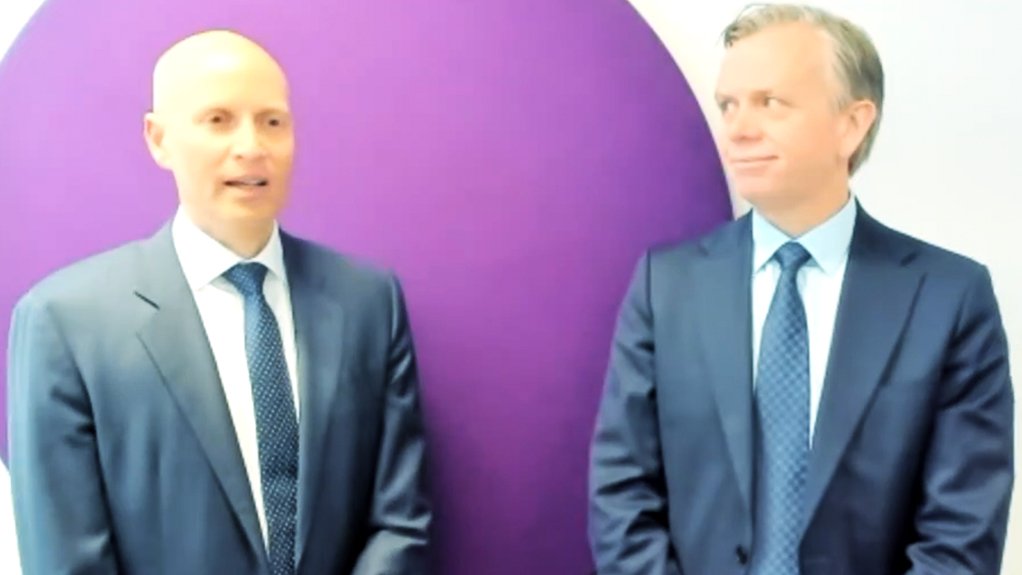
Nel ASA CEO Håkon Volldal and Nel CFO Kjell Christian Bjørnsen.
Photo by Creamer Media
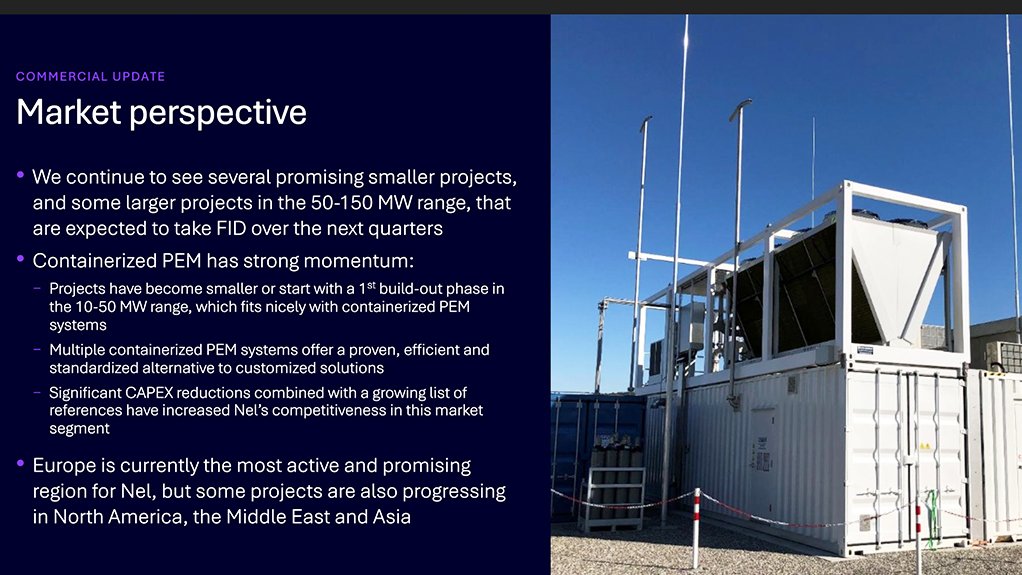
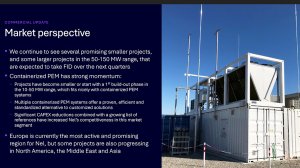
Containerised PEM.
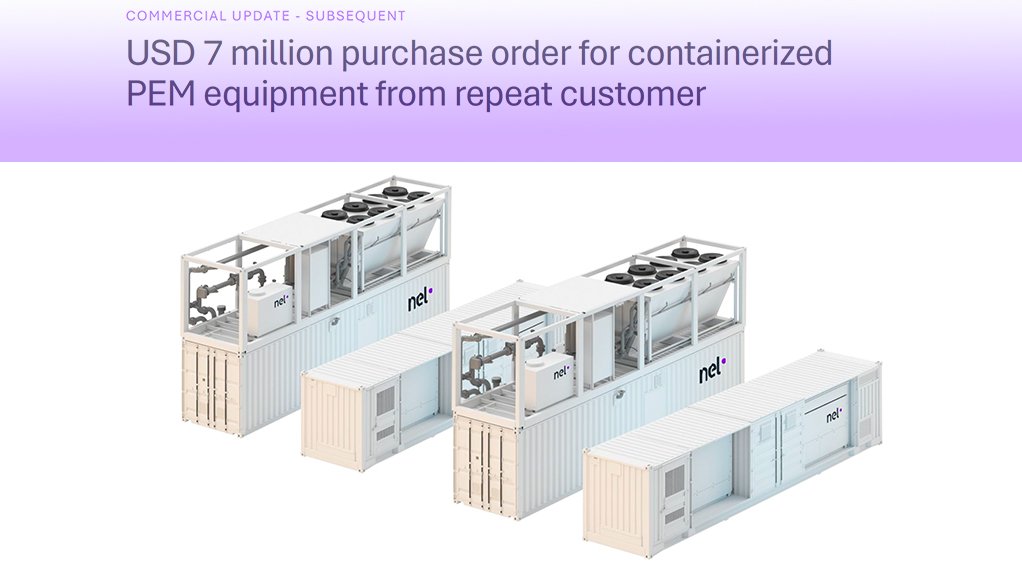
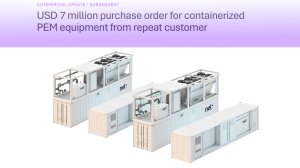
Containerised PEM.
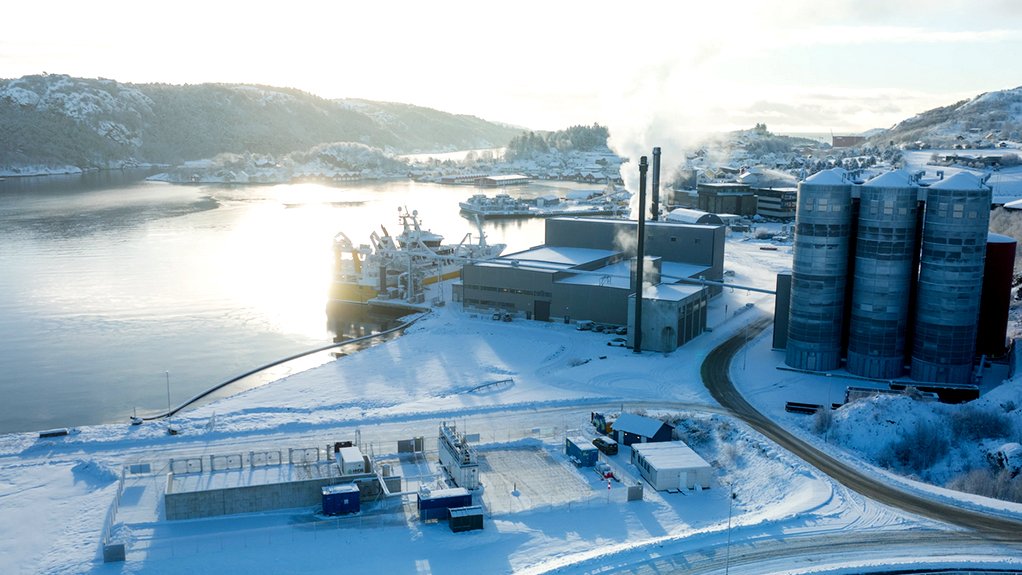
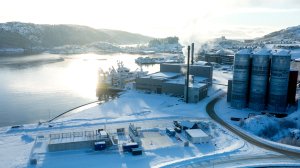
Green hydrogen plant in Norway.



JOHANNESBURG (miningweekly.com) – Electrolytic hydrogen enables long-term energy storage way beyond what batteries can provide, which is exemplified by a 200 MW hydrogen plant in the United States having larger storage capacity than all the batteries currently linked to the electricity grid in the United States, including the batteries from Tesla.
“That’s the big thing about hydrogen,” Nel ASA president and CEO Håkon Volldal emphasised during question time, following the Norway-based company’s presentation of first-quarter results in Oslo on Wednesday, April 22.
“We need to take a fresh look at our energy system and a stronger focus needs to be placed on renewable hydrogen, which can be produced locally and close to end‑users,” said Volldal after reporting a second purchase order by Mesure Process for containerised proton exchange membrane (PEM) electrolyser equipment. PEM electrolysers make use of platinum and iridium, platinum group metals (PGMs) which South Africa hosts in abundance.
“The momentum for containerised PEM solutions is picking up. The good thing about that solution is that we have a fairly short delivery time on containerised PEM solutions.
“We can deliver systems in less than 12 months. The order we booked in April will be delivered in 2027. If we get orders now until the year end, I think we have an opportunity to deliver all of those, or close to all of those, in 2027, so we’re hopeful that we can book more containerised PEM solutions,” Volldal enthused.
The goal for the next generation PEM under development is to slash the stack cost by a whopping 70%.
Mining Weekly: When do you expect to launch the next-generation PEM?
Volldal: If I could give you an exact date, I would, but if there's one thing we learned is that technology development is uncertain, it takes time. There are always tricky things that you need to overcome that could be pertaining to the concept design itself, could be pertaining to availability of materials, or you end up with a cost that you don't like, so you have to re-engineer it. With PEM, we have the ambition to build a full prototype stack this year. Then that has to be tested, and then we need to spend some time to get partners to help us industrialise it. So, it will take a couple of years - whether that means we can launch it in mid- 2028 or late 2028 or in 2029, I'm not able to say at the moment.
The benefit of the new PEM platform is that our goal is to take the cost down by 70% on the stack level, and in a PEM system, the stack is the most expensive component. That means we can significantly reduce capital expenditure (capex). It will be a low capex, low opex solution, so that's the Holy Grail. You get the cake and you can eat it. It's comparable with pressurised alkaline. It might have even better energy efficiency, and it could have a smaller footprint at a lower cost. The response is, as always with PEM, fantastic. So, it's more dynamic than pressurised alkaline, even though, I have to say, for larger pressurised alkaline systems, you also have fantastic dynamic capabilities. But we believe that this is something that will be even more competitive than the new alkaline product that we will launch on May 6, and that's why we continue to work on it.
Should I read PEM equals PGM?
Yes, but the iridium loading and the platinum loading is very limited. We will utilise much less iridium and platinum. The use of these will be at a very different level compared with what we see today.
IDEAL FOR CONTAINERISED PEM
In addition to the promising smaller projects that are ideal for a containerised PEM, larger projects in the 50 MW to 150 MW range are also emerging and these are expected to take on final-investment-decision status over the next quarters.
“The reason why containerised PEM has strong momentum is that projects have become smaller than we saw a couple of years ago.
“Then, customers spoke about 100 MW, 200 MW, 300 MW, 400 MW. Now, they plan for something smaller, at least initially. They want a gradual approach, where they build out capacity over time, when offtake materialises.
“If they start with the first step, that's usually in the 10 MW to 50 MW range, and that fits nicely with the containerised PEM systems.
“Multiple containerised PEM systems offer a proven, efficient and standardised alternative to customised and tailored solutions.
“We’ve achieved significant capex reductions over the past few years, both on the stack itself and on the system designed. Combined with a growing list of references that we have around the world, this has increased Nel’s competitiveness in this market segment.
“Europe is currently the most active and promising region, but we also have projects and deliveries in North America and interesting prospects in the Middle East and Asia,” it was reported during the company’s presentation of results, covered by Mining Weekly.
Hydrogen was hailed as being “at another level” when it comes to the amounts of energy that can be stored.
Providing an example of how hydrogen can help to flatten out the demand curve for electricity, Volldal drew attention to a 20 MW plant in Denmark.
“This plant is run when there is excess energy in the system. So, instead of them bringing prices down to a very low level, this helps prices stay more or less stable, because they can also shut down the equipment when demand for electrons is high,” he explained.
The 20 MW facility helps to balance out the peaks and troughs of electricity demand.
Implementing this on a larger scale will help avoid periods where operators and generators get absolutely nothing for the electricity they produce but also help consumers avoid periods when demand is high and electricity prices go through the roof. It basically helps to flatten out the price curve for electricity.
With a century of experience, Nel has sold more than 7 000 hydrogen-generating electrolysers globally, and has many technology platforms spanning PEM and alkaline.
“We have proven solutions for today, but we need new solutions for tomorrow. We need solutions that can bring the total cost of hydrogen down, and we don't develop that only here in Nel.
“We do it through a big network of world-class partners. We make big leaps in terms of innovation and how we look at cost-down opportunities, and they combine that with market-leading production capabilities,” Volldal outlined.
HYDROGEN’S LONG-TERM STORAGE POTENTIAL
Mining Weekly: For how long can the hydrogen be stored and when it is released, do fuel cells then turn it back into electricity that is green, clean and emission-free?
Volldal: There are different ways of storing hydrogen. You can store it in a buffer tank for large quantities of energy to be stored. You can even use a pipeline, or you can use salt caverns. There are salt caverns used in Sweden for storage. There are pipelines being used with compressed hydrogen, you can liquefy it and store it in a tank. So there are different ways of storing the energy, and if you want to turn it back into electricity, you have to run the hydrogen through a fuel cell again to generate that electricity, which you can use on site, or send it back to the grid.
Electricity can't be stored for that long but you’re pointing out that hydrogen can?
That's the big thing about hydrogen. You turn it into a molecule that you can store for a very long period of time, we’re talking years, if necessary. There is always a little bit of a loss, what we call a boil off, but that's a Mickey Mouse figure compared with the total amount of energy that you store. So, whereas batteries can help you smoothen out short-term swings, it's very difficult with batteries to store large amounts of energy and use that, let’s say, when you need more energy during the winter. But it's difficult to store that in the summer and release it in the winter. With hydrogen, you can do that, even over multiple years. So, that's where batteries and hydrogen serve different purposes. But I think both are needed to have an energy system that we can depend on.
Can you use the existing infrastructure, existing tanks, or do you have to get special new tanks?
In some places you have infrastructure in place that you can leverage in all the places you have to build that storage capacity.
DEFENCE SECTOR
Asked about the supply by Nel to the defence sector, Volldal spoke of Nel having a number of defence sector-linked collaborations and Nel CFO Kjell Christian Bjørnsen reported that for years, the company had been receiving grants from the Department of Defense in the US to work on hydrogen as part of an energy resilient infrastructure.
"On the outlook for order intake currently, we do not have enough to really field meaningful utilisation in 2027 but we have, you know, good reasons to believe that we will see order intake this year that will help us have meaningful activity levels in 2027. When it comes to cash balance, we have taken quite some actions. In addition to the personnel expenses being reduced, we have worked a lot on other external spending. And I do believe that we can stretch that cash balance fairly long, if it takes even longer to get orders. We're not stressed with the size of our cash balance."
On the momentum for containerised PEM solutions picking up, Volldal elaborated: “The good thing about that solution is that we have a fairly short delivery time on containerised PEM solutions.
“We can deliver systems in less than 12 months. The order we booked in April will be delivered in 2027. If we get orders now until the year-end, I think we have an opportunity to deliver all of those, or close to all of those, in 2027, so we are hopeful that we can book more containerised PEM solutions,” he added.
ENERGY RESILIENCE
Renewable energy can reduce exposure to certain price spikes and definitely help mitigate geopolitical dependency.
Investing in renewable energy and green hydrogen is cheaper than repeat short-term subsidy programmes for fossil energy, and it also reduces emissions.
Hydrogen should thus be the overwhelming part of debates about energy resilience and security of supply.
Article Enquiry
Email Article
Save Article
Feedback
To advertise email advertising@creamermedia.co.za or click here
Research Reports

Projects
Latest Multimedia
Latest News
Showroom
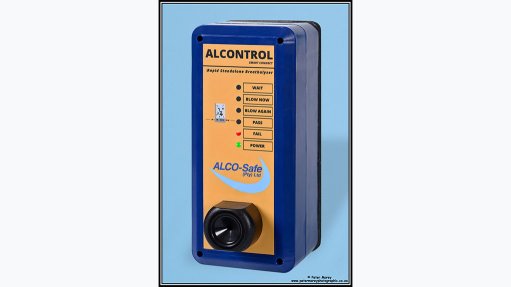
Developed to exceed the latest EN 15964 standards for police breathalysers proving that it will remain accurate and reliable for many years to come.
VISIT SHOWROOM
We at Hawk High Pressure Pumps specialise in industrial pumps and pumping systems. Our high pressure washing equipment is locally manufactured and...
VISIT SHOWROOM
Press Office
Announcements
What's On
Subscribe to improve your user experience...
Option 1 (equivalent of R125 a month):
Receive a weekly copy of Creamer Media's Engineering News & Mining Weekly magazine
(print copy for those in South Africa and e-magazine for those outside of South Africa)
Receive daily email newsletters
Access to full search results
Access archive of magazine back copies
Access to Projects in Progress
Access to ONE Research Report of your choice in PDF format
Option 2 (equivalent of R375 a month):
All benefits from Option 1
PLUS
Access to Creamer Media's Research Channel Africa for ALL Research Reports, in PDF format, on various industrial and mining sectors
including Electricity; Water; Energy Transition; Hydrogen; Roads, Rail and Ports; Coal; Gold; Platinum; Battery Metals; etc.
Already a subscriber?
Forgotten your password?
Receive weekly copy of Creamer Media's Engineering News & Mining Weekly magazine (print copy for those in South Africa and e-magazine for those outside of South Africa)
➕
Recieve daily email newsletters
➕
Access to full search results
➕
Access archive of magazine back copies
➕
Access to Projects in Progress
➕
Access to ONE Research Report of your choice in PDF format
RESEARCH CHANNEL AFRICA
R4500 (equivalent of R375 a month)
SUBSCRIBEAll benefits from Option 1
➕
Access to Creamer Media's Research Channel Africa for ALL Research Reports on various industrial and mining sectors, in PDF format, including on:
Electricity
➕
Water
➕
Energy Transition
➕
Hydrogen
➕
Roads, Rail and Ports
➕
Coal
➕
Gold
➕
Platinum
➕
Battery Metals
➕
etc.
Receive all benefits from Option 1 or Option 2 delivered to numerous people at your company
➕
Multiple User names and Passwords for simultaneous log-ins
➕
Intranet integration access to all in your organisation