Compliance Cannot Stop at Tender Award


This article has been supplied and will be available for a limited time only on this website.
More than 6,000 employers were named by the Financial Sector Conduct Authority (FSCA) in its July 2026 update on retirement-fund contribution arrears. Total arrears were estimated at R8.33 billion, affecting approximately 590,000 retirement-fund members. While these figures reflect a national issue rather than the construction and building sectors alone, they highlight the consequences when employers fail to meet their obligations to workers.
For the Building Industry Bargaining Council (BIBC), this reinforces why compliance cannot be treated as a once-off requirement at the point a contract is awarded. While a BIBC Certificate of Good Standing or Compliance Certificate confirms a contractor’s status when it is issued, that position can change while a project is under way. Without further verification, subsequent lapses may go unnoticed until workers or other businesses are affected, potentially leaving workers out of pocket or disrupting project delivery.
“In some cases, our agents have found that a contractor’s compliance did not extend beyond the date shown on its certificate,” says Danie Hattingh, spokesperson for business at the BIBC. “The challenge is ensuring that contractors continue to meet their obligations once work is under way, particularly as project arrangements change.”
The consequences of non-compliance can reach well beyond the business at fault. On sites where several contractors and subcontractors operate alongside one another, a single employer’s failure to comply can expose others to additional risks.
“BIBC agents have witnessed how workers attempting to evade detection during inspections can create further safety hazards on construction sites, putting themselves and others at risk,” says Hattingh.
Workers can also suffer direct financial losses. These may include incorrect wage payments, missed negotiated increases and unpaid retirement, holiday, sick, severance or other required benefits. Regular verification of compliance status can help identify discrepancies before unpaid amounts build up and become harder to recover. Keeping accurate employment and payroll records is an equally important legal requirement, particularly when workers leave a job and need to access benefits to which they are entitled.
Consistent enforcement is equally important to compliant employers who meet their obligations. Businesses that pay the required wages and contributions should not have to compete against those that cut costs by underpaying workers.
Failure to maintain compliance can in turn have operational consequences for contractors. Employment disputes, workforce turnover and unresolved payment issues can affect productivity, planning and continuity on site. A stable workforce, supported by fair employment practices, appropriate skills and effective supervision, gives contractors a stronger foundation for delivering work efficiently and avoiding preventable interruptions.
Responsibility for maintaining standards is shared across the contracting chain, continues Hattingh. “Clients and developers can make compliance expectations explicit in tender and contract documentation, while principal contractors should verify subcontractors’ credentials and revisit those checks as work progresses.” Keeping records of verification and following up on identified shortcomings can help ensure that problems are addressed rather than being allowed to persist.
Subcontractors remain accountable for their own employees, wage payments, contributions and employment records. Workers can assist by cooperating with inspections and raising concerns through the appropriate channels, but the duty to meet employer obligations remains with the business employing them.
Coordination between industry bodies and public authorities is another part of this picture. “The BIBC continues to work with the City of Cape Town on coordinated enforcement at tender application stage and during construction projects, while comparable arrangements have yet to be established at provincial level,” says Hattingh.
The Council has also observed growth in the number of employers recorded as compliant, alongside greater willingness among compliant businesses to flag suspected breaches by competitors. Such reporting can help bring unfair practices to light and support more consistent enforcement.
For Hattingh, the priority is to ensure that compliance remains part of how a project is managed, rather than a requirement addressed only when work is awarded.
Several practical steps can be implemented to maintain ongoing accountability, including:
• Re-verifying certificates at set intervals, such as each payment certificate or project milestone.
• Requiring a valid compliance certificate before releasing progress payments.
• Extending compliance requirements to all subcontractors.
• Maintaining a verification log.
“A tender award should be the beginning of accountability, not the end of scrutiny. Ongoing monitoring and cooperation between industry stakeholders are essential to protecting workers, supporting responsible employers and maintaining compliance throughout a project.”
Article Enquiry
Email Article
Save Article
Feedback
To advertise email advertising@creamermedia.co.za or click here
Research Reports


Projects


Latest Multimedia



Showroom
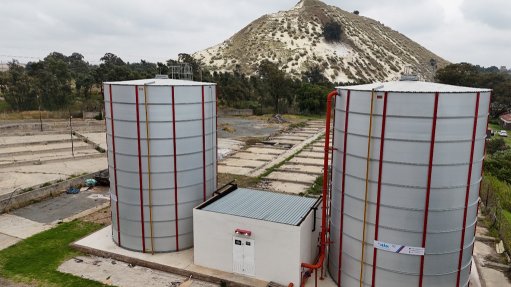
Videx Water Storage Tanks designs, manufactures and installs sectional and cylindrical steel water storage tanks and reservoirs across Africa.
VISIT SHOWROOM
Established in 1983, the ASTPM is an industry association and representative body of the welded carbon steel tube and pipe manufacturers of South...
VISIT SHOWROOM



Announcements
What's On
Subscribe to improve your user experience...
Option 1 (equivalent of R125 a month):
Receive a weekly copy of Creamer Media's Engineering News & Mining Weekly magazine
(print copy for those in South Africa and e-magazine for those outside of South Africa)
Receive daily email newsletters
Access to full search results
Access archive of magazine back copies
Access to Projects in Progress
Access to ONE Research Report of your choice in PDF format
Option 2 (equivalent of R375 a month):
All benefits from Option 1
PLUS
Access to Creamer Media's Research Channel Africa for ALL Research Reports, in PDF format, on various industrial and mining sectors
including Electricity; Water; Energy Transition; Hydrogen; Roads, Rail and Ports; Coal; Gold; Platinum; Battery Metals; etc.
Already a subscriber?
Forgotten your password?
Receive weekly copy of Creamer Media's Engineering News & Mining Weekly magazine (print copy for those in South Africa and e-magazine for those outside of South Africa)
➕
Recieve daily email newsletters
➕
Access to full search results
➕
Access archive of magazine back copies
➕
Access to Projects in Progress
➕
Access to ONE Research Report of your choice in PDF format
RESEARCH CHANNEL AFRICA
R4500 (equivalent of R375 a month)
SUBSCRIBEAll benefits from Option 1
➕
Access to Creamer Media's Research Channel Africa for ALL Research Reports on various industrial and mining sectors, in PDF format, including on:
Electricity
➕
Water
➕
Energy Transition
➕
Hydrogen
➕
Roads, Rail and Ports
➕
Coal
➕
Gold
➕
Platinum
➕
Battery Metals
➕
etc.
Receive all benefits from Option 1 or Option 2 delivered to numerous people at your company
➕
Multiple User names and Passwords for simultaneous log-ins
➕
Intranet integration access to all in your organisation