Urgent need for one-stop mineral rights shop, Minerals Council points out



JOHANNESBURG (miningweekly.com) – There is an urgent need for a one-stop shop for mineral right applications to coordinate and align all relevant regulations from other departments, to streamline and expedite approval processes.
This was pointed out explicitly at the 136th AGM of Minerals Council South Africa on Wednesday, May 27.
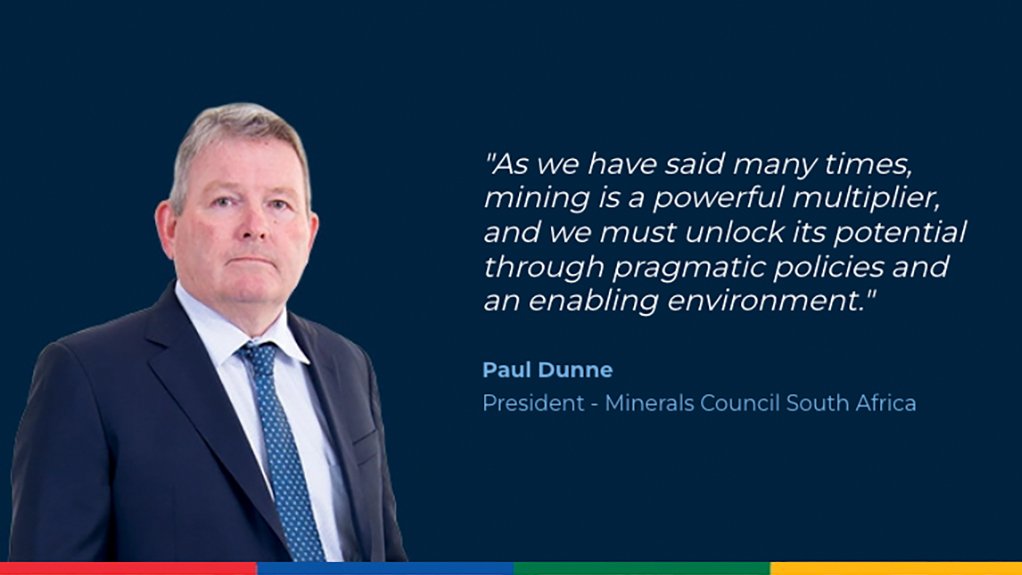
“The prevailing fragmented system results in delays and lost opportunities. A shared vision in the government of the importance of mining and the role it plays in our economy and society is essential,” Minerals Council president Paul Dunne explained at the AGM covered by Mining Weekly.
The AGM came together during one of the most important moments in recent years for the South African mining sector with a fundamental sea change underway as the Department of Mineral and Petroleum Resources (DMPR) is further revising the Mineral and Petroleum Resources Development Act (MPRDA), which was gazetted 22 years ago in April 2004.
South Africa had, Dunne said, a long history of robust engagements in policy developments with the DMPR, with moments of positive outcome, but also moments of disagreements ending up in court.
“These were unnecessary developments that damaged sentiment and perceptions of South Africa as a mining investment destination, and which, we trust, will never be repeated,” Dunne stated.
Since 2004, South African mining had operated under the Mining Charter, which had positioned the mining sector as one of the country’s most transformed economic clusters.
The MPRDA marked a profound change in the way mining operated by vesting all unmined minerals in the custodianship of the State, ending private mineral ownership.
It ensured the participation of all South Africans who were previously excluded from full participation in one of South Africa’s most important industrial clusters.
It ensured that companies looked beyond their mine gates to uplift communities through investments and partnerships, and to create fairer, more equitable and inclusive workplaces.
Around the time it was gazetted, women representation in mining, which is now at 21%, was around 3%, with mining companies meeting or exceeding economic empowerment ownership targets.
“It’s unfortunate, however, that while the Act has delivered profound social change and transformation in the mining sector, it has fallen short of its aspiration to create an internationally competitive and efficient administrative and regulatory regime,” Dunne reported.
Mining’s contribution to GDP in 2025 was 6.2%, virtually flat compared with 6.3% when the Act was gazetted in 2004.
Simply put, South African mining was not – and had not been – growing in any meaningful way for a multitude of reasons, including electricity shortages, above-inflation energy tariffs, logistics bottlenecks, regulatory uncertainty and poor administration of the law.
The past 22 years had been marred, Dunne noted, by disputes between the regulator, and the Minerals Council and its members, which were often resolved in court.
In 2013, a Bill to amend the MPRDA spent more than 2 000 days in various proceedings before being withdrawn amid profound unhappiness about its proposed amendments.
“The negative impact of the prolonged regulatory uncertainty that those proposed amendments caused for the mining sector must not be understated. A repetition of drawn-out wrangling, because of an ill-considered Amendment Bill, which does not reflect our engagements with the DMPR, must be avoided at all costs,” Dunne urged in reference to the latest Mineral Resources Development (MRD) Bill expected later this year.
Coupled with the uncertainty caused by the previous Bill, there had been four versions of the Mining Charter, each setting revised targets or developing new ones.
As a result, South Africa’s mining sector had not been able to deliver to its full potential in the past 22 years.
Mining needed an Act that would encourage and sustain long-term investment and growth in exploration and new mine development.
“We’re encouraged by the nature of the engagements we have had with the DMPR since the draft MRD Bill was gazetted a year ago. However, we don’t want to be surprised by a revised version of the MRD Bill that does not reflect the engagements we have held,” Dunne pleaded.
The Minerals Council had held extensive talks in good faith with officials in the DMPR to develop laws that would make South Africa a globally attractive exploration and mining destination.
“Both sides agree on the need to revitalise our nationally important sector,” Dunne disclosed, adding that doing so would lift South Africans out of poverty.
South Africa exported R816-billion worth of minerals last year and contributed R124-billion in taxes to the fiscus.
Each of the 470 457 people employed by mining supported ten more jobs in the mineral value chain and ancillary industries, meaning more than 4.7-million livelihoods depend on mining.
“As we’ve said many times, mining is a powerful multiplier, and we must unlock its potential through pragmatic policies and an enabling environment.
“I must stress: A thriving mining industry, with a rich pipeline of exploration projects and new mines, is essential for South Africa and the future of its citizens.
“Legislation alone will not achieve that ambition. The laws and regulations must be administered efficiently, honestly and transparently.
"Fundamental to globally competitive mineral rights management is a modern, world-class mining cadastre that removes human interference, streamlines applications, makes geological information easily accessible from anywhere in the world, and delivers the utmost transparency,” Dunne emphasised.
Article Enquiry
Email Article
Save Article
Feedback
To advertise email advertising@creamermedia.co.za or click here
Research Reports
Projects

Latest Multimedia

Latest News
Showroom

North Ridge Pumps is an independent manufacturer of pumps. We have a proven track record for product support and customer service throughout the...
VISIT SHOWROOM
As a reticulator, Egoli Gas provides natural gas to homes and businesses via underground pipes.
VISIT SHOWROOM
Announcements
What's On
Subscribe to improve your user experience...
Option 1 (equivalent of R125 a month):
Receive a weekly copy of Creamer Media's Engineering News & Mining Weekly magazine
(print copy for those in South Africa and e-magazine for those outside of South Africa)
Receive daily email newsletters
Access to full search results
Access archive of magazine back copies
Access to Projects in Progress
Access to ONE Research Report of your choice in PDF format
Option 2 (equivalent of R375 a month):
All benefits from Option 1
PLUS
Access to Creamer Media's Research Channel Africa for ALL Research Reports, in PDF format, on various industrial and mining sectors
including Electricity; Water; Energy Transition; Hydrogen; Roads, Rail and Ports; Coal; Gold; Platinum; Battery Metals; etc.
Already a subscriber?
Forgotten your password?
Receive weekly copy of Creamer Media's Engineering News & Mining Weekly magazine (print copy for those in South Africa and e-magazine for those outside of South Africa)
➕
Recieve daily email newsletters
➕
Access to full search results
➕
Access archive of magazine back copies
➕
Access to Projects in Progress
➕
Access to ONE Research Report of your choice in PDF format
RESEARCH CHANNEL AFRICA
R4500 (equivalent of R375 a month)
SUBSCRIBEAll benefits from Option 1
➕
Access to Creamer Media's Research Channel Africa for ALL Research Reports on various industrial and mining sectors, in PDF format, including on:
Electricity
➕
Water
➕
Energy Transition
➕
Hydrogen
➕
Roads, Rail and Ports
➕
Coal
➕
Gold
➕
Platinum
➕
Battery Metals
➕
etc.
Receive all benefits from Option 1 or Option 2 delivered to numerous people at your company
➕
Multiple User names and Passwords for simultaneous log-ins
➕
Intranet integration access to all in your organisation