Ramaphosa highlights the investment prospects being unlocked by ‘irreversible’ reforms

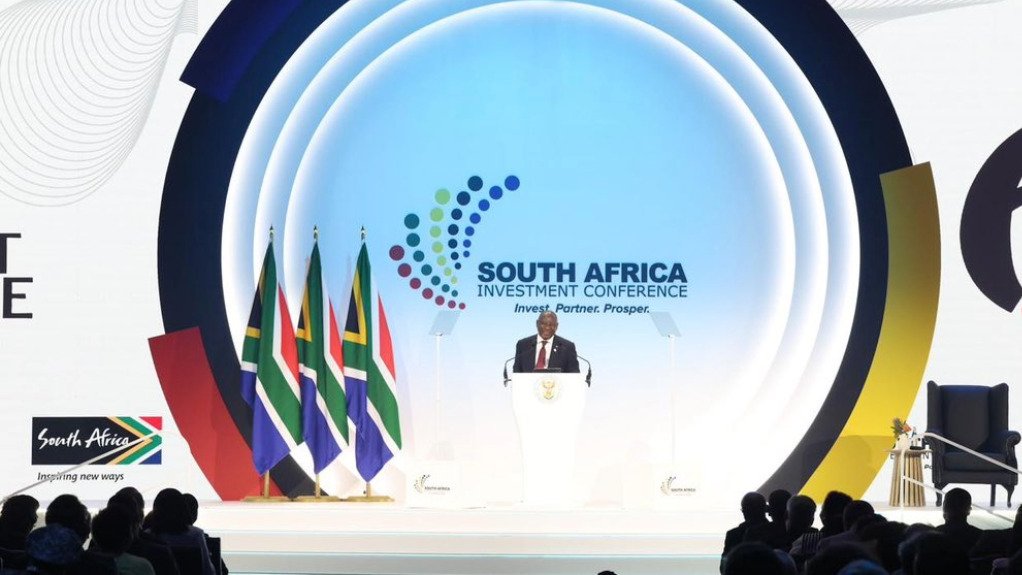
President Cyril Ramaphosa speaking at the 2026 edition of the South Africa Investment Conference in Sandton


President Cyril Ramaphosa used the 2026 edition of the South Africa Investment Conference (SAIC) to highlight the new prospects being opened to domestic and foreign investors by the country’s ongoing economic reforms, which he described as “irreversible”.
The sixth edition of the SAIC drew 1 200 delegates from 50 countries and is the first such gathering to be hosted since 2023, as well as the first since the formation of the multi-party Government of National Unity, which Ramaphosa leads.
The President used the event to announce a new R2-trillion investment-pledge target for the period from 2026 to 2030, outlining opportunities across a diverse range of sectors but emphasising that the ‘Three D’s’ of decarbonisation, digitisation and diversification would increasingly shape the country’s industrial strategy.
He also reiterated government’s claim that the first cycle, between 2018 and 2023, had yielded pledges of R1.5-trillion against a target of R1.2-trillion.
There remains much scepticism about the impact of those pledges, with critics pointing out that they failed to materially lift overall investment and employment levels over the period and that many of the projects were merely sustaining in nature.
Nevertheless, Ramaphosa used the previous SAIC gatherings to showcase South Africa as a viable investment destination even in difficult circumstances, with the first SAIC cycle having coincided with a period of extreme electricity disruptions, as well as the social and economic fallout associated with the Covid-19 pandemic.
“Even amidst these strong headwinds, the South African economy has maintained core financial and institutional stability,” Ramaphosa said in his address.
Meanwhile, Trade, Industry and Competition Minister Parks Tau insisted that R600-billion of the R1.2-trillion that had been pledged at previous investment conferences had “flowed into the real economy”.
FUEL PRICE HEADWIND?
Speaking this year against a backdrop of an impending fuel-price shock, which has been somewhat softened by a temporary R3/l reduction in the general fuel levy from April 1 to May 5, Ramaphosa acknowledged the growth and investment risks associated with unfolding geopolitical fragmentation, wars and trade tensions.
However, he argued that South Africa was in a position to offer investors a “favourable proposition as a resilient, credible and reform-oriented investment destination with strong fundamentals”.
The reforms under way in electricity, freight logistics, water and infrastructure, he asserted, were also opening up new avenues for private sector participation in areas hitherto monopolised by State-owned companies.
Transport Minister Barbara Creecy listed several private sector participation opportunities arising in the freight logistics sector, including upcoming tenders for a manganese export corridor and terminal at the Port of Ngqura, in the Eastern Cape, and the container corridor between Gauteng and the Port of Durban, in KwaZulu-Natal.
Electricity and Energy Minister Dr Kgosientsho Ramokgopa, meanwhile, said South Africa was poised to invest more than R2-trillion on new generation linked to the Integrated Resource Plan for electricity and a further R440-billion on transmission infrastructure, some of which would be built through private independent transmission projects.
Finance Minister Enoch Godongwana added that the introduction of competition in the electricity and logistics sectors, together with other reforms, could help lift GDP growth from about 1.6% currently to above 3%, but that these reforms would succeed only if the macroeconomic fundamentals were also in place.
On that front, Godongwana highlighted an improving fiscal balance, ratings upgrades and a falling inflation rate.
He said market consensus pointed to the energy shock arising from disruptions to shipping in the Strait of Hormuz following the attack on Iran by the US and Israel increasing inflation to above the 3% target, but within the one percentage point tolerance band.
Minister Tau, meanwhile, also emphasised microeconomic interventions, reporting that attention was being given to reducing regulatory approval timelines, including by using a ‘Fusion Centre’ to identify blockages and “resolve them in real time”.
“Beyond project-level facilitation, we are advancing structural remedies. The Omnibus Fast-tracking Act will enable streamlined licensing, fast-tracked visas for scarce skills, and digitised permits across multiple regulatory domains.
“Legislative and policy amendments are being progressed to remove the systemic blockages that no amount of case-by-case intervention can resolve,” Tau added.
RECOVERY TO EXPANSION
Ramaphosa argued that, underpinned by the ongoing reform momentum, the 2026 investment conference marked the “formal transition from recovery to expansion, from rebuilding confidence to accelerating growth”.
“A question is often asked: is this momentum of reform sustainable? Will we see it being sustained into the future? And my simple answer is, yes. The reform process that we are on now is irrevocable and irreversible, because it is in the interests of our economy and of our people.”
Ramaphosa said that, by ending inefficient monopolies and introducing competition, South Africa aimed to reduce the cost of electricity and transport over time, enabling manufacturing, mining, agriculture and other industries to thrive and to compete.
“With one monopoly, innovation is quite lacking. With one monopoly, there are inefficiencies that come in. So, with diverse operators, we find competition actually has greater benefits,” Ramaphosa said.
Article Enquiry
Email Article
Save Article
Feedback
To advertise email advertising@creamermedia.co.za or click here
Research Reports

Projects
Latest Multimedia
Latest News
Showroom
Iritron delivers advanced automation, control, and optimisation solutions to the Mining, Minerals & Metals, Consumer Package Goods and...
VISIT SHOWROOM
ZF Aftermarket is the after-sales division of the world-renowned German ZF group, a global leader in mobility technology.
VISIT SHOWROOM
Announcements
What's On
Subscribe to improve your user experience...
Option 1 (equivalent of R125 a month):
Receive a weekly copy of Creamer Media's Engineering News & Mining Weekly magazine
(print copy for those in South Africa and e-magazine for those outside of South Africa)
Receive daily email newsletters
Access to full search results
Access archive of magazine back copies
Access to Projects in Progress
Access to ONE Research Report of your choice in PDF format
Option 2 (equivalent of R375 a month):
All benefits from Option 1
PLUS
Access to Creamer Media's Research Channel Africa for ALL Research Reports, in PDF format, on various industrial and mining sectors
including Electricity; Water; Energy Transition; Hydrogen; Roads, Rail and Ports; Coal; Gold; Platinum; Battery Metals; etc.
Already a subscriber?
Forgotten your password?
Receive weekly copy of Creamer Media's Engineering News & Mining Weekly magazine (print copy for those in South Africa and e-magazine for those outside of South Africa)
➕
Recieve daily email newsletters
➕
Access to full search results
➕
Access archive of magazine back copies
➕
Access to Projects in Progress
➕
Access to ONE Research Report of your choice in PDF format
RESEARCH CHANNEL AFRICA
R4500 (equivalent of R375 a month)
SUBSCRIBEAll benefits from Option 1
➕
Access to Creamer Media's Research Channel Africa for ALL Research Reports on various industrial and mining sectors, in PDF format, including on:
Electricity
➕
Water
➕
Energy Transition
➕
Hydrogen
➕
Roads, Rail and Ports
➕
Coal
➕
Gold
➕
Platinum
➕
Battery Metals
➕
etc.
Receive all benefits from Option 1 or Option 2 delivered to numerous people at your company
➕
Multiple User names and Passwords for simultaneous log-ins
➕
Intranet integration access to all in your organisation