Panellists emphasise importance of policy implementation for effective tailings management, land rehabilitation

Panellists during Creamer Media’s Tailings webinar discussed how responsible tailings management and effective land rehabilitation is becoming increasingly important for environmental protection, public health and sustainable economic development


While responsible tailings management and effective land rehabilitation are increasingly recognised as important for environmental protection, public health and sustainable economic development, better and more streamlined implementation of regulatory frameworks and policies is needed to accelerate progress in South Africa.
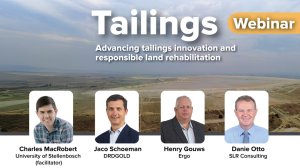
This was one of the topics discussed during Creamer Media’s Tailings webinar, held on April 8, during which industry experts discussed the evolution of tailings in the country and explored various themes such as regulatory, financial, technical and social barriers that may be slowing rehabilitation efforts across the country.
Stellenbosch University Department of Civil Engineering geotechnical engineering Associate Professor Charles MacRobert led the panel which included SLR Consulting asset transition and closure business lead and Land Rehabilitation Society of Southern Africa president Danie Otto, DRDGold COO Jaco Schoeman and Ergo MD Henry Gouws.
During the discussion, MacRobert enquired about policy and financing changes that needed to take place to help unlock South Africa’s tailings opportunities.
In response, Otto highlighted the importance of obtaining closure certificates, describing this as the “elephant in the room”.
“I think that's one specific aspect we have to address,” he said, adding that new legislation in terms of rehabilitation and funding required for closure purposes was imminent. The new legislation will look at latent and residual risks in more detail than previously.
Schoeman, meanwhile, described local regulatory frameworks and polices as being “up there with the best in the world”. However, issues of implementation, adhering to timelines and getting authorisations through in a timely manner were hampering efforts.
“I think it's a case where there's just too many applications and not enough officials to complete the work, let alone speed up the process,” he said.
“We also believe that the Department [of Mineral and Petroleum Resources] is under-resourced to answer all of these applications, both from a human capacity as well as a technology capacity [perspective]. But I don't think that there's anything wrong with our regulations or our policies. It's a case of can we speed up the process? Can we move things along sooner?” he added.
Gouws agreed, expressing that there were limited avenues available to discuss challenges that may be faced in projects, thereby creating a “tick-box exercise” for companies.
“What we are finding is that it becomes a tick-box exercise, and you either meet fully or don't meet requirements. I believe that we've got to try and find a pragmatic solution to be able to engage with these authorities,” he added.
“The conclusion you're reaching here is that really, there aren't really policy changes that need to be made. It's just that we need to be implementing what we've already got in place faster and realising the benefits of the work that's being proposed to fix up these old facilities,” MacRobert replied.
Meanwhile, responding to questions from viewers regarding abandoned tailings storage facilities in Gauteng, Gouws pointed out potential issues with the cadastre system, which he described as “out of date”.
South Africa has started the phased roll-out of a digital cadastre to streamline mining right applications, reduce backlogs and provide real-time, geospatial data on mining areas and rights. The cadastre replaces the outdated and manually updated South African Mineral Resources Administration System that was first introduced in 2011.
The creation of the digital cadastre took many years, resulting in legal challenges over claims.
“I don't think there’s a single day that I'm not confronted with somebody [claiming] ownership or otherwise rights to facilities [that others also claim to hold],” he said.
Hence, the panellists agreed on the need to expedite authorisations and enhance regulatory certainty.
Additionally, the panellists also discussed the role of technology in ensuring sustainable post-mining land use, with Otto citing various technological breakthroughs in the sector, including developments in seed technology and hyperaccumulation, developments in geochemistry and remote sensing.
Article Enquiry
Email Article
Save Article
Feedback
To advertise email advertising@creamermedia.co.za or click here
Research Reports


Projects

Latest Multimedia


Latest News

Showroom

North Ridge Pumps is an independent manufacturer of pumps. We have a proven track record for product support and customer service throughout the...
VISIT SHOWROOM
As a reticulator, Egoli Gas provides natural gas to homes and businesses via underground pipes.
VISIT SHOWROOM


Announcements
What's On
Subscribe to improve your user experience...
Option 1 (equivalent of R125 a month):
Receive a weekly copy of Creamer Media's Engineering News & Mining Weekly magazine
(print copy for those in South Africa and e-magazine for those outside of South Africa)
Receive daily email newsletters
Access to full search results
Access archive of magazine back copies
Access to Projects in Progress
Access to ONE Research Report of your choice in PDF format
Option 2 (equivalent of R375 a month):
All benefits from Option 1
PLUS
Access to Creamer Media's Research Channel Africa for ALL Research Reports, in PDF format, on various industrial and mining sectors
including Electricity; Water; Energy Transition; Hydrogen; Roads, Rail and Ports; Coal; Gold; Platinum; Battery Metals; etc.
Already a subscriber?
Forgotten your password?
Receive weekly copy of Creamer Media's Engineering News & Mining Weekly magazine (print copy for those in South Africa and e-magazine for those outside of South Africa)
➕
Recieve daily email newsletters
➕
Access to full search results
➕
Access archive of magazine back copies
➕
Access to Projects in Progress
➕
Access to ONE Research Report of your choice in PDF format
RESEARCH CHANNEL AFRICA
R4500 (equivalent of R375 a month)
SUBSCRIBEAll benefits from Option 1
➕
Access to Creamer Media's Research Channel Africa for ALL Research Reports on various industrial and mining sectors, in PDF format, including on:
Electricity
➕
Water
➕
Energy Transition
➕
Hydrogen
➕
Roads, Rail and Ports
➕
Coal
➕
Gold
➕
Platinum
➕
Battery Metals
➕
etc.
Receive all benefits from Option 1 or Option 2 delivered to numerous people at your company
➕
Multiple User names and Passwords for simultaneous log-ins
➕
Intranet integration access to all in your organisation