Opportunity knocks in Africa’s energy transition


KESH MUDALY Electricity systems become financially and economically viable when they serve productive demand



Africa’s energy transition presents a significant opportunity to expand electricity access, stimulate industrial growth and attract private capital, provided that investment frameworks, grid infrastructure and policy certainty evolve to support long-term deployment, highlights Boston Consulting Group MD and partner Kesh Mudaly.
He notes that while substantial global capital is earmarked for the energy transition, emerging markets continue to face structural barriers that slow investment, adding that the challenge is therefore not just the absence of capital scarcity, but the mechanisms required to mobilise and deploy it effectively.
“Achieving universal energy access across Africa is estimated to require about $150-billion of investment by 2035, implying yearly spending of roughly $15-billion. Current deployment of about $2-billion to $3-billion a year suggests significant room to scale investment and broaden participation by private and institutional capital.
“Even where capital is pledged, projects often struggle to reach financial close. The issue is not simply that Africa is ‘riskier’, it is that risk is often difficult to price correctly,” says Mudaly.
As a result, projects in emerging markets frequently face a cost of capital five to six percentage points above developed-market peers owing to uncertainty around tariffs, contract frameworks and currency exposure.
However, Mudaly notes that practical solutions exist to improve bankability and accelerate deployment including standardised documentation, scaled guarantee mechanisms, improved project preparation facilities and clearer tariff and grid roadmaps that can materially enhance investor confidence.
“The objective is not to eliminate risk, but to price and allocate it correctly. Where this has occurred, private capital has followed, and rather than framing these issues as barriers, they represent areas where coordinated policy and institutional innovation can unlock opportunity,” he adds.
Grid, Investment Enablers
Mudaly emphasises that grid infrastructure remains the central enabler of Africa’s energy transition, as the continent faces the dual task of modernising ageing networks while expanding electricity access to underserved populations.
“More than 600-million Africans remain without electricity. Expanding and strengthening transmission infrastructure is therefore not only about integrating renewable and low carbon energy – it is fundamental to supporting economic development and universal access,” he says.
He explains that grid expansion, when executed effectively, serves two purposes simultaneously: connecting the unconnected while improving reliability for those already on the system.
“Reliable transmission networks underpin both improved access and the integration of renewable and low-carbon generation. Regional interconnections, congestion management tools and appropriately deployed microgrids can further enhance resilience and broaden pathways to electrification,” Mudaly notes.
However, he cautions that renewable energy expansion must be sequenced with system flexibility.
“As renewable generation scales, power systems must evolve in parallel. Greater penetration of variable renewables requires complementary flexibility – including storage technologies, demand-side management and flexible generation such as gas-to-power. These are structural components of a modern power system, not optional add-ons,” he says.
Mudaly adds that demand growth is equally critical to ensuring that new energy investment is economically sustainable.
“Electricity systems become financially and economically viable when they serve productive demand. Industrial expansion, mining growth and data-driven industries are expected to drive rising consumption across the continent. Reliable power enables industrial growth, and industrial growth strengthens the economics of further energy investment,” he explains.
Mudaly points to critical minerals as a clear illustration of this dynamic.
“In Zambia alone, an additional 5 TW/h of electricity a year will be required by 2030 to support targeted copper production. This demonstrates the direct link between energy infrastructure and industrial expansion,” Mudaly says.
Rather than viewing grid constraints as a structural limitation, Mudaly argues they should be seen as a signal for coordinated investment.
“Grid constraints highlight where capital and policy need to move faster. When transmission build-out is aligned with industrial expansion, energy infrastructure becomes a catalyst for value creation and economic diversification,” he says.
Investor-Friendly Policies, Affordability
Although regulatory progress varies across Africa, robust and consistently implemented policy frameworks remain essential to attracting long-term investment. In several markets, reforms are strengthening procurement practices, clarifying grid access provisions and enhancing institutional independence.
Mudaly notes that predictability is often more important than perfection.
“Investors can price construction and operational risk, but they struggle to price regulatory volatility. Clear and consistently implemented rules around grid access, storage participation and market settlement mechanisms are therefore critical to unlocking sustained capital deployment,” he says.
Where frameworks are coherent and consistent, investment accelerates. Where uncertainty persists, projects tend to remain in development without reaching financial close.
Balancing decarbonisation with affordability and employment considerations remains another central policy objective, particularly in coal-dependent regions. These trade-offs are real, but they are not necessarily zero-sum.
Mudaly adds that the first 30% to 40% of renewable-energy penetration in many systems can be cost-competitive and supportive of job creation; however, higher levels of penetration require additional investment in storage, grid infrastructure and system flexibility, but remain economically viable when properly sequenced.
He emphasises that local-content requirements can also enhance energy security but must be implemented carefully.
“When phased appropriately, they build domestic capability and strengthen supply chain resilience. When applied rigidly or prematurely, they risk delaying projects, increasing system-wide costs and weakening competitiveness,” he explains.
With this in mind, Mudaly argues that the energy transition should ultimately be framed as a value-creation opportunity rather than a cost burden.
“With effective market design, policy consistency and trust-based public–private partnership, the transition can attract investment, stimulate industrial demand and support economic growth. When done properly, it strengthens competitiveness rather than undermines it,” he concludes.
Article Enquiry
Email Article
Save Article
Feedback
To advertise email advertising@creamermedia.co.za or click here
Research Reports

Projects

Latest Multimedia


Showroom

M and J Mining are leading suppliers of physical support systems as used by the underground mining industry. Our selection of products are not...
VISIT SHOWROOM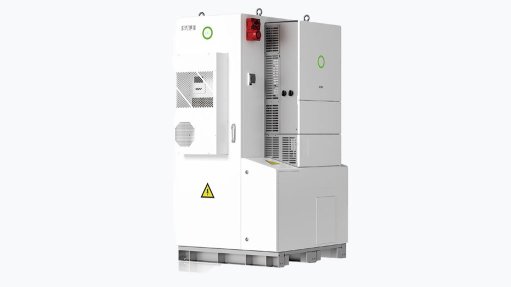
Smart energy storage solutions for efficient, safe, and profitable power.
VISIT SHOWROOM

Press Office
Announcements
What's On
Subscribe to improve your user experience...
Option 1 (equivalent of R125 a month):
Receive a weekly copy of Creamer Media's Engineering News & Mining Weekly magazine
(print copy for those in South Africa and e-magazine for those outside of South Africa)
Receive daily email newsletters
Access to full search results
Access archive of magazine back copies
Access to Projects in Progress
Access to ONE Research Report of your choice in PDF format
Option 2 (equivalent of R375 a month):
All benefits from Option 1
PLUS
Access to Creamer Media's Research Channel Africa for ALL Research Reports, in PDF format, on various industrial and mining sectors
including Electricity; Water; Energy Transition; Hydrogen; Roads, Rail and Ports; Coal; Gold; Platinum; Battery Metals; etc.
Already a subscriber?
Forgotten your password?
Receive weekly copy of Creamer Media's Engineering News & Mining Weekly magazine (print copy for those in South Africa and e-magazine for those outside of South Africa)
➕
Recieve daily email newsletters
➕
Access to full search results
➕
Access archive of magazine back copies
➕
Access to Projects in Progress
➕
Access to ONE Research Report of your choice in PDF format
RESEARCH CHANNEL AFRICA
R4500 (equivalent of R375 a month)
SUBSCRIBEAll benefits from Option 1
➕
Access to Creamer Media's Research Channel Africa for ALL Research Reports on various industrial and mining sectors, in PDF format, including on:
Electricity
➕
Water
➕
Energy Transition
➕
Hydrogen
➕
Roads, Rail and Ports
➕
Coal
➕
Gold
➕
Platinum
➕
Battery Metals
➕
etc.
Receive all benefits from Option 1 or Option 2 delivered to numerous people at your company
➕
Multiple User names and Passwords for simultaneous log-ins
➕
Intranet integration access to all in your organisation