No room for compromise: Protecting quality in plastic pipes






This article has been supplied.
In a country where reliable water and sanitation infrastructure remains both a pressing need and a long-term national priority, the role of the Southern African Plastic Pipe Manufacturers Association (SAPPMA) has never been more critical. As South Africa prepares for renewed infrastructure investment and increasing urbanisation, ensuring the quality and longevity of plastic piping systems is essential.
As the voluntary, self-regulating, non-profit association representing plastic pipe manufacturers and key stakeholders across the industry, with membership comprising the majority of leading players in Southern Africa, SAPPMA continues to lead from the front.
“Plastic pipes form the backbone of modern water reticulation and sanitation systems. With South Africa currently consuming approximately 94 900 tonnes of PVC pipes and around 52 000 tonnes of HDPE pipes annually, the sector plays a significant role in enabling service delivery. Demand for these materials is structurally linked to economic growth and infrastructure development. As GDP expands, so too does the need for reliable piping systems to support housing, industry, mining and municipal services,” says Jan Venter, CEO of SAPPMA.
While the economy has entered a period of prolonged stagnation and is expected to continue through 2026 to 2030, there are signs of gradual recovery on the horizon. Forecasts suggest average annual GDP growth of around 2% between 2025 and 2035, with a more conservative 2.2% projected for the early 2030s. A more infrastructure-friendly political environment, potentially in the form of a GNU 2.0 by 2029, could further stimulate investment in civil infrastructure. This, in turn, bodes well for the plastic pipe industry, particularly from 2028 onwards when new build activity is expected to accelerate.
At the same time, South Africa faces a growing urban population, projected to rise from the current 63% to over 70% by 2030–2035. This rapid urbanisation will place additional strain on existing water and sanitation systems, many of which are already in urgent need of maintenance and upgrades.
The dual challenge of rehabilitating ageing infrastructure, while expanding capacity, underscores the importance of high-quality, durable piping solutions. However, as market conditions become more challenging (driven in part by high virgin polymer prices and economic pressure), the risk of sub-standard manufacturing practices increases. This is a concern that Jan Venter, CEO of SAPPMA, has consistently highlighted.
“During times of economic pressure, there is always a temptation for some manufacturers to cut corners in order to remain competitive. This is precisely when quality assurance becomes even more critical. Inferior pipes may offer short-term cost savings, but they inevitably lead to long-term failures, higher maintenance costs, and ultimately, compromised service delivery,” he warns.
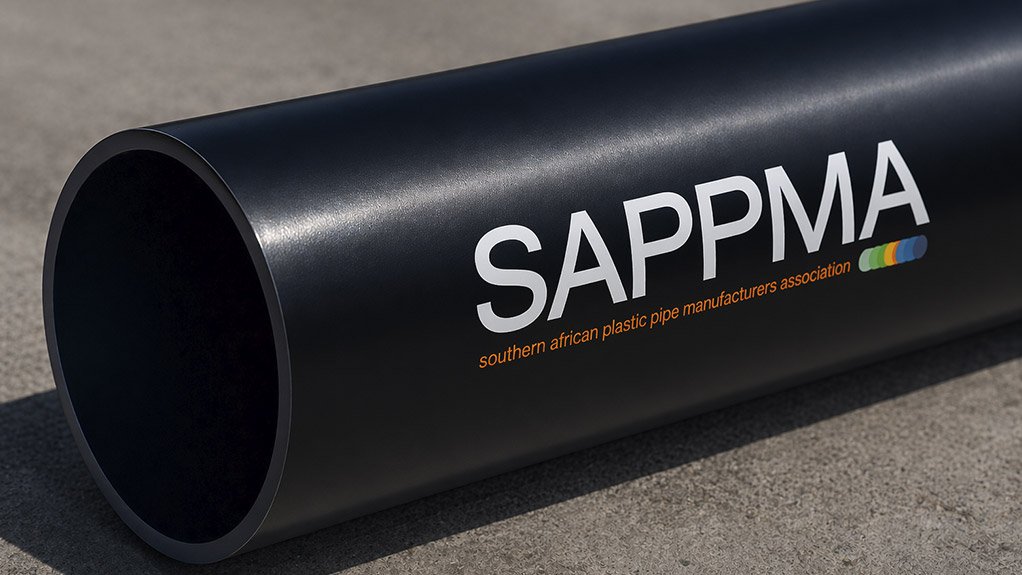
SAPPMA’s mandate is to safeguard the integrity of the plastic pipe industry by enforcing strict adherence to national and international standards. Through its rigorous audit processes, product testing and member compliance requirements, the association ensures that only high-quality, fit-for-purpose pipes bearing the SAPPMA logo are used in critical infrastructure projects.
Adds Venter: “Quality is not negotiable. Every pipe installed in a water or sanitation system must perform reliably for decades. Our role at SAPPMA is to hold manufacturers accountable and to provide assurance to engineers, municipalities and the public that our members meet the highest standards.”
Beyond compliance, SAPPMA also plays a vital role in education and industry advocacy. By engaging with engineers, specifiers and government stakeholders, the association promotes best practices in pipe selection, installation and maintenance. This holistic approach helps to ensure that infrastructure investments deliver maximum value over their lifespan.
Looking ahead, the outlook for the plastic pipe industry is cautiously optimistic. While HDPE demand has remained relatively flat since 2022/23, anticipated growth in mining and civil infrastructure from 2028 onwards is expected to provide a much-needed uplift. Similarly, the ongoing need for maintenance and the anticipated surge in new infrastructure projects will continue to drive demand for PVC pipes.
Yet, as the industry grows, the importance of maintaining quality standards cannot be overstated. In a sector where failure can have far-reaching consequences for public health, environmental sustainability and economic development, the work done by SAPPMA serves as indispensable guardian of quality and accountability.
“Infrastructure is only as strong as the materials used to build it. By ensuring consistent quality in plastic pipes, we are not just supporting the industry. We are helping to secure South Africa’s water future,” Venter concludes.
Article Enquiry
Email Article
Save Article
Feedback
To advertise email advertising@creamermedia.co.za or click here
Research Reports

Projects

Latest Multimedia

Latest News


Showroom
Axiom Hydraulics is a trusted leader in South Africa’s hydraulic industry, delivering world-class components, systems, and engineering expertise...
VISIT SHOWROOM
Sulzer South Africa, established in 1922, partners with critical industries like power, oil & gas, water, mining, and chemicals to boost...
VISIT SHOWROOM

Announcements
What's On
Subscribe to improve your user experience...
Option 1 (equivalent of R125 a month):
Receive a weekly copy of Creamer Media's Engineering News & Mining Weekly magazine
(print copy for those in South Africa and e-magazine for those outside of South Africa)
Receive daily email newsletters
Access to full search results
Access archive of magazine back copies
Access to Projects in Progress
Access to ONE Research Report of your choice in PDF format
Option 2 (equivalent of R375 a month):
All benefits from Option 1
PLUS
Access to Creamer Media's Research Channel Africa for ALL Research Reports, in PDF format, on various industrial and mining sectors
including Electricity; Water; Energy Transition; Hydrogen; Roads, Rail and Ports; Coal; Gold; Platinum; Battery Metals; etc.
Already a subscriber?
Forgotten your password?
Receive weekly copy of Creamer Media's Engineering News & Mining Weekly magazine (print copy for those in South Africa and e-magazine for those outside of South Africa)
➕
Recieve daily email newsletters
➕
Access to full search results
➕
Access archive of magazine back copies
➕
Access to Projects in Progress
➕
Access to ONE Research Report of your choice in PDF format
RESEARCH CHANNEL AFRICA
R4500 (equivalent of R375 a month)
SUBSCRIBEAll benefits from Option 1
➕
Access to Creamer Media's Research Channel Africa for ALL Research Reports on various industrial and mining sectors, in PDF format, including on:
Electricity
➕
Water
➕
Energy Transition
➕
Hydrogen
➕
Roads, Rail and Ports
➕
Coal
➕
Gold
➕
Platinum
➕
Battery Metals
➕
etc.
Receive all benefits from Option 1 or Option 2 delivered to numerous people at your company
➕
Multiple User names and Passwords for simultaneous log-ins
➕
Intranet integration access to all in your organisation