Interdisciplinary framework needed


ANGEL MOKGOKOLO Essentially, the Engineering Intelligence Hub takes a real project and brings it into the classroom as a learning resource



Incorporating the practical realities of engineering and infrastructure projects into classroom learning resources can meaningfully augment the engineering and technical skills pipeline and support Africa’s infrastructure development, says Maukq and Company founder Angel Mokgokolo.
Maukq and Company is developing a framework that connects schools with real engineering projects across numerous sectors.
The initiative aims to address a persistent disconnect between science, technology, engineering and mathematics (STEM) education theoretical classroom learning and the practical realities of consulting engineering projects.
Mokgokolo highlights that the company identified the challenges many educators experience when required to deliver STEM lessons using limited practical teaching resources.
“At the beginning of the year, teachers are given clear guidelines on what must be taught and assessed, but we are not given resources to support those topics, and without practical examples of real infrastructure or engineering systems, learners often struggle to understand how the scientific concepts they study translate into careers in engineering, mining or energy.”
To better understand this challenge, Mokgokolo conducted research among Grade 9 learners studying natural sciences and technology in 2025 to determine whether limited exposure to engineering applications influenced their future career aspirations.
While many learners choose science subjects in Grade 10, the research indicated that their eventual career ambitions frequently fall outside the STEM fields, with learners often gravitating towards professions they are familiar with, such as teaching, medicine or law, owing to these careers being visible in their daily lives.
“Engineering and infrastructure development, by contrast, remain largely invisible to learners and they cannot envision themselves working in these industries, [as] they have never been exposed to them,” Mokgokolo adds.
Classroom–Industry Nexus
Maukq and Company therefore developed the Engineering Intelligence Hub, a framework designed to translate real engineering projects into teaching and learning resources aligned with South Africa’s curriculum.
“Essentially, the Engineering Intelligence Hub takes a real project and brings it into the classroom as a learning resource.”
This approach enables learners to understand not only the scientific principles behind infrastructure systems but also the multidisciplinary teams involved in designing and implementing such projects.
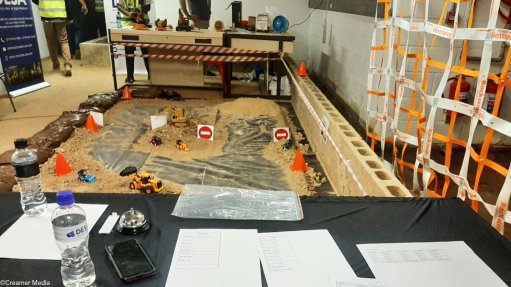
The hub collaborates with companies willing to share information about projects they are implementing, and the technical processes and engineering concepts behind these projects are then simplified into classroom resources such as diagrams, charts, visual aids and scaled models.
These materials enable teachers to integrate real-world engineering examples into lessons on topics such as environmental sustainability, mining systems and energy generation.
The framework focuses primarily on sectors already embedded in the national curriculum for Grades 7 to 9, including mining, energy systems and environmental sustainability. However, Mokgokolo says the concept is expanding to additional sectors – such as construction, agriculture and architecture – as industry partnerships grow.
In some cases, industry partners may also support the programme by providing mobile classroom installations or demonstration models that allow learners to visualise engineering infrastructure and systems.
Early feedback from classrooms where the framework has been introduced suggests that learners’ perceptions of engineering careers begin to shift once they are exposed to real-world examples.
Educators participating in the programme have also reported greater awareness of the engineering concepts already embedded in the science and technology curriculum.
However, implementation has presented challenges, particularly where schools initially associate STEM initiatives primarily with coding and robotics programmes rather than broader engineering concepts.
Nonetheless, Mokgokolo believes that stronger collaboration among the consulting engineering industry, education sector and communities will be essential to developing Africa’s future engineering workforce.
Article Enquiry
Email Article
Save Article
Feedback
To advertise email advertising@creamermedia.co.za or click here
Research Reports

Projects
Latest Multimedia


Showroom
M and J Mining are leading suppliers of physical support systems as used by the underground mining industry. Our selection of products are not...
VISIT SHOWROOM
Smart energy storage solutions for efficient, safe, and profitable power.
VISIT SHOWROOM

Press Office
Announcements
What's On
Subscribe to improve your user experience...
Option 1 (equivalent of R125 a month):
Receive a weekly copy of Creamer Media's Engineering News & Mining Weekly magazine
(print copy for those in South Africa and e-magazine for those outside of South Africa)
Receive daily email newsletters
Access to full search results
Access archive of magazine back copies
Access to Projects in Progress
Access to ONE Research Report of your choice in PDF format
Option 2 (equivalent of R375 a month):
All benefits from Option 1
PLUS
Access to Creamer Media's Research Channel Africa for ALL Research Reports, in PDF format, on various industrial and mining sectors
including Electricity; Water; Energy Transition; Hydrogen; Roads, Rail and Ports; Coal; Gold; Platinum; Battery Metals; etc.
Already a subscriber?
Forgotten your password?
Receive weekly copy of Creamer Media's Engineering News & Mining Weekly magazine (print copy for those in South Africa and e-magazine for those outside of South Africa)
➕
Recieve daily email newsletters
➕
Access to full search results
➕
Access archive of magazine back copies
➕
Access to Projects in Progress
➕
Access to ONE Research Report of your choice in PDF format
RESEARCH CHANNEL AFRICA
R4500 (equivalent of R375 a month)
SUBSCRIBEAll benefits from Option 1
➕
Access to Creamer Media's Research Channel Africa for ALL Research Reports on various industrial and mining sectors, in PDF format, including on:
Electricity
➕
Water
➕
Energy Transition
➕
Hydrogen
➕
Roads, Rail and Ports
➕
Coal
➕
Gold
➕
Platinum
➕
Battery Metals
➕
etc.
Receive all benefits from Option 1 or Option 2 delivered to numerous people at your company
➕
Multiple User names and Passwords for simultaneous log-ins
➕
Intranet integration access to all in your organisation