Glencore poised to benefit from Newcastle coal price surge and some gas-to-coal switching

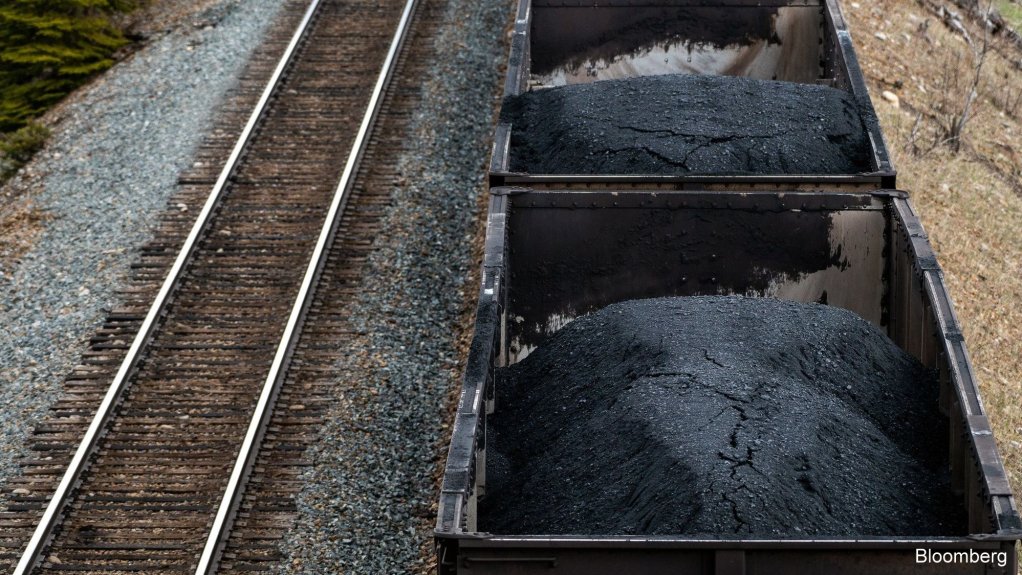


Diversified miner Glencore is set to benefit from Newcastle coal prices trending above $165/t since the US and Israel’s conflict started with Iran on February 28.
The coal price currently exceeds consensus by 42%.
Market research agency Bloomberg Intelligence says coal has emerged as a promising alternative given disruption in liquefied natural gas (LNG) supply.
The disruption could trigger between 40-million and 60-million tons of gas-to-coal switching across Europe and Asia.
While countries are effectively short on energy sources and face rising costs, Glencore will naturally benefit from gas-to-coal switching.
Bloomberg Intelligence says Glencore’s earnings for the year could increase by 14% year-on-year to reach $20-billion in a prolonged conflict scenario this year.
The company is uniquely positioned among mining majors to withstand an energy price shock, with a natural hedge in thermal coal and trading that directly benefits from LNG flows being disrupted.
Glencore’s peers are effectively “short energy”, facing higher input costs without a corresponding top-line benefit, leaving Glencore structurally better placed relative to its competition, Bloomberg Intelligence states.
The current threat to the Strait of Hormuz, which Bloomberg Intelligence says is a chokepoint for 25% of seaborne oil and 20% of global LNG, reintroduces geographic and price dislocations such as those that enabled Glencore to generate record profit in 2022 – a result of the energy crisis stemming from the Russian invasion of Ukraine.
Glencore’s trading desk thrives on this “war premium”, capturing arbitrage as thermal coal, oil and gas prices decouple from fundamentals.
By leveraging its vast logistics network to reroute energy cargoes and navigate rising freight volatility, Glencore can extract margins that its pure-play mining peers cannot.
While not yet comparable in scale, the current disruption echoes the dynamics of early 2022 when Glencore's marketing earnings doubled compared with normalised levels. The company can likely reach beyond the top of its long-term earnings guidance range of between $2.3-billion and $3.5-billion.
In Bloomberg Intelligence’s base case of a one-to-two-month disruption to LNG exports from the Gulf, it estimates Newcastle prices could rise to $185/t. In a more protracted scenario of three months or longer, prices could reach between $185/t and $245/t.
Conversely, a near-term resolution and reopening of the Strait could see coal retrace, although Qatar’s Ras Laffan LNG plant could be offline for months, which will continue to support coal prices above $125/t.
Moreover, Bloomberg Intelligence says miners such as Whitehaven and Peabody are more exposed to metallurgical coal, which does not directly benefit from energy market dislocations, though lower-rank metallurgical coals can compete with thermal coal in some applications.
Coal miners Yancoal and New Hope have also enjoyed the 17% higher Newcaste and 21% higher API2 prices, while coal prices in South Africa at Richards Bay terminal have lagged at 12% higher.
SWITCHING DYNAMICS
Bloomberg Intelligence predicts up to 90-million tonnes of additional coal demand could be necessary owing to fuel switching in a full-stress scenario – though realisation of this would depend on how utilities respond to gas dislocation.
The agency continues that fuel switching is neither immediate nor uniform. “Utilities need available coal units, sufficient inventories and contractual flexibility. Constraints include emissions policy, run-hour limits and maintenance and logistics.
“This means switching of gas to coal builds over weeks and is often partial. Europe and Japan account for nearly 80% of high-calorific value switching potential,” the agency notes.
It adds that at between 40-million and 60-million tonnes of practical switching potential across Europe, Japan, South Korea and Taiwan, the demand uplift is meaningful relative to the one-billion-tonne seaborne thermal coal market. The effect is more acute in the high-calorific segment where seaborne supply comprises less than 400-million tonnes.
As switching demand is concentrated in higher-calorific coals, this disproportionately tightens availability from key exporters such as Australia, Colombia and South Africa, increasing competition for prompt cargoes, with Newcastle prices likely to capture a larger share of the gas-to-coal switching premium.
By contrast, China is less of a swing factor, given its reliance on domestic supply and preference for mid-calorific value imports.
Bloomberg Intelligence points out that thermal coal prices are unlikely to respond to the current LNG disruption in the same way as in 2022, when coal rallied alongside gas as both markets faced simultaneous supply shocks – including sanctions on Russian coal and weather-related disruption to Australian exports.
By contrast, the current supply shock is concentrated in LNG. The scope for additional gas-to-coal switching is also more limited, since European coal capacity has declined since 2022 and North Asian utilities are constrained by existing LNG contract structures, as well as operational limits on coal plants.
Therefore, the conditions that drove the extraordinary coal rally in 2022 are largely absent.
Nonetheless, a prolonged conflict scenario would increase coal burn across many regions.
Article Enquiry
Email Article
Save Article
Feedback
To advertise email advertising@creamermedia.co.za or click here
Research Reports

Projects

Latest Multimedia

Latest News
Showroom

Stewarts & Lloyds is a leading steel, tube, and engineering product supplier in South Africa.
VISIT SHOWROOM
Columbus Stainless, based in Middelburg, Mpumalanga, is Africa’s only producer of stainless steel flat products. In addition, Columbus is the only...
VISIT SHOWROOM


Announcements
What's On
Subscribe to improve your user experience...
Option 1 (equivalent of R125 a month):
Receive a weekly copy of Creamer Media's Engineering News & Mining Weekly magazine
(print copy for those in South Africa and e-magazine for those outside of South Africa)
Receive daily email newsletters
Access to full search results
Access archive of magazine back copies
Access to Projects in Progress
Access to ONE Research Report of your choice in PDF format
Option 2 (equivalent of R375 a month):
All benefits from Option 1
PLUS
Access to Creamer Media's Research Channel Africa for ALL Research Reports, in PDF format, on various industrial and mining sectors
including Electricity; Water; Energy Transition; Hydrogen; Roads, Rail and Ports; Coal; Gold; Platinum; Battery Metals; etc.
Already a subscriber?
Forgotten your password?
Receive weekly copy of Creamer Media's Engineering News & Mining Weekly magazine (print copy for those in South Africa and e-magazine for those outside of South Africa)
➕
Recieve daily email newsletters
➕
Access to full search results
➕
Access archive of magazine back copies
➕
Access to Projects in Progress
➕
Access to ONE Research Report of your choice in PDF format
RESEARCH CHANNEL AFRICA
R4500 (equivalent of R375 a month)
SUBSCRIBEAll benefits from Option 1
➕
Access to Creamer Media's Research Channel Africa for ALL Research Reports on various industrial and mining sectors, in PDF format, including on:
Electricity
➕
Water
➕
Energy Transition
➕
Hydrogen
➕
Roads, Rail and Ports
➕
Coal
➕
Gold
➕
Platinum
➕
Battery Metals
➕
etc.
Receive all benefits from Option 1 or Option 2 delivered to numerous people at your company
➕
Multiple User names and Passwords for simultaneous log-ins
➕
Intranet integration access to all in your organisation