German, South African organisations launch project to support workers in the energy transition

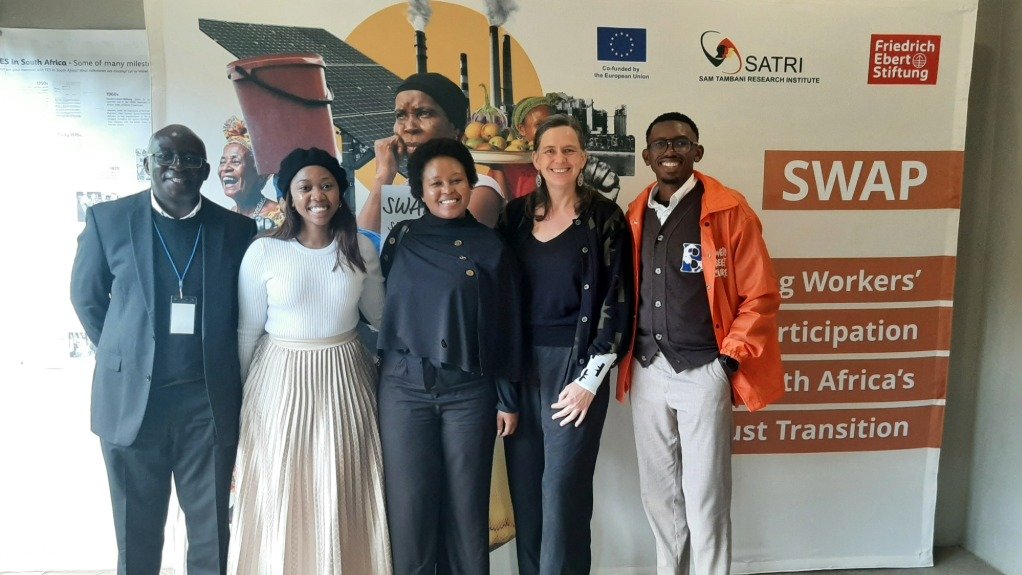


German political foundation Friedrich-Ebert-Stiftung South Africa (FES SA), in partnership with the South African nonprofit organisation (NPO) the Sam Tambani Research Institute (SATRI), on April 14 launched the Strengthening Workers’ Active Participation in South Africa’s Just Transition project (SWAP).
The project’s objective is to strengthen the capacities of at-risk workers, communities and community-based associations and organisations (CBAOs) to negotiate with local authorities and the private sector in Mpumalanga, KwaZulu-Natal and Limpopo for a just and worker-centric transition from coal to renewable energies and low-emission green value chains.
Co-founded by the EU, it will work directly with workers, communities, women and trade unions in Mpumalanga, Limpopo and KwaZulu-Natal, which are expected to be the most affected by the gradual decommissioning of South Africa’s coal-fired power stations.
The project will run for two years from March this year to February 2028.
Its total budget is about €1.05-million, comprising €1-million from the EU and over €52 000 from FES SA.
At the launch in Johannesburg, speakers acknowledged the need for a transition in South Africa, with the country being the largest greenhouse-gas emitter in Africa, and heavily dependent on coal mining that underpins about 70% of its energy sources.
Mpumalanga accounts for over 80% of coal production.
However, the transition from coal-fired to renewable power must be balanced with social objectives.
Coal mining is a labour-intensive industry, and its value chain accounts for considerable employment figures and supports many other stakeholders. The reduction in reliance on coal infrastructure impacts these jobs, in a country that is already grappling with a high unemployment rate.
In terms of the project’s targeted regions, Limpopo has a 35% unemployment rate, Mpumalanga 34%, and KwaZulu-Natal 33.4%.
The project aims to address this by including the most impacted, who are often left out of the decision-making process.
FES SA project leader Sthandiwe Msomi explained that this “pioneer project” is pursuing three outputs. First, local communities will be brought together, with financial support from third-party (FSTP) initiatives led by CBAOs or NPOs, to shape gender-just demands and policy proposals for a just transition in the coal mining and energy sector.
Second, it will educate at least two trade unions from the mining and energy sector, workers and community members and relevant policy makers on just transition best practices and experiences from international and local case studies.
Third, workers and community members will be trained to negotiate post-decommissioning support packages and to discuss the need to co-design local value chains, applying these skills in two pilot communities to demand binding just transition dialogues with employers and authorities for a just transition toward a net zero economy.
Msomi outlined six target groups for the project. First, the project is expected to reach about 514 workers, comprising a minimum of 35% women. It will capacitate the workers through training, workshops and development of a just transition advocacy blueprint to strengthen their bargaining power; and enable them to shape a just transition that creates sustainable jobs and incorporates gender justice.
Second, the project is targeting 516 community members, with a minimum of 40% women. It will strengthen community capacity through workshop consultations and support to local CBAOs, enabling them to participate meaningfully in shaping transition strategies.
Third, the project is targeting at least 50 local government officials, with a minimum of 35% women. It will build the capacity of local officials through training and dialogue to ensure that local governance structures can better respond to transition impacts and engage with communities.
Fourth, it is targeting three CBAOs and/or NPOs receiving FSTP to conduct community consultation workshops.
It will provide CBAOs with financial support as implementing partners for the action; provide them with financial resources and technical capacities to organise, coordinate and facilitate dialogues working with the project team; strengthen their role in consultation workshops; and ensure local ownership of transition processes.
Fifth, it is targeting two pilot communities, consisting of 60 individuals from the first three target groups. It will enable these companies to test and refine strategies for achieving just transition outcomes by piloting that just transition advocacy blueprint in real negotiations.
Lastly, it is targeting at least two trade unions from the mining and energy sectors. It will educate them on just transition best practices and experiences from international and local case studies that will benefit their members and shop-stewards to advance a coherent strategy towards the just transition.
Overall, the project is expected to benefit about 160 000 workers in the coal and energy sectors, about 23.7-million people from communities across the target provinces and all trade unions in the country across federations.
The launch was welcomed by representatives from the EU, FES SA and SATRI, with CBAOs and unions also expressing their support.
It is anticipated that the project will provide a blueprint for other countries in the region that are undergoing just energy transition processes.
Article Enquiry
Email Article
Save Article
Feedback
To advertise email advertising@creamermedia.co.za or click here
Research Reports

Projects

Latest Multimedia
Latest News
Showroom
For over 15 years, Lilak Aluminium, a trusted leader in architectural extrusion supply, has delivered excellence to businesses like yours.
VISIT SHOWROOM
ISO-certified Condra manufactures overhead cranes, portal cranes, cantilever cranes and crane components: hoists, drives, end-carriages, brakes and...
VISIT SHOWROOM
Press Office
Announcements
What's On
Subscribe to improve your user experience...
Option 1 (equivalent of R125 a month):
Receive a weekly copy of Creamer Media's Engineering News & Mining Weekly magazine
(print copy for those in South Africa and e-magazine for those outside of South Africa)
Receive daily email newsletters
Access to full search results
Access archive of magazine back copies
Access to Projects in Progress
Access to ONE Research Report of your choice in PDF format
Option 2 (equivalent of R375 a month):
All benefits from Option 1
PLUS
Access to Creamer Media's Research Channel Africa for ALL Research Reports, in PDF format, on various industrial and mining sectors
including Electricity; Water; Energy Transition; Hydrogen; Roads, Rail and Ports; Coal; Gold; Platinum; Battery Metals; etc.
Already a subscriber?
Forgotten your password?
Receive weekly copy of Creamer Media's Engineering News & Mining Weekly magazine (print copy for those in South Africa and e-magazine for those outside of South Africa)
➕
Recieve daily email newsletters
➕
Access to full search results
➕
Access archive of magazine back copies
➕
Access to Projects in Progress
➕
Access to ONE Research Report of your choice in PDF format
RESEARCH CHANNEL AFRICA
R4500 (equivalent of R375 a month)
SUBSCRIBEAll benefits from Option 1
➕
Access to Creamer Media's Research Channel Africa for ALL Research Reports on various industrial and mining sectors, in PDF format, including on:
Electricity
➕
Water
➕
Energy Transition
➕
Hydrogen
➕
Roads, Rail and Ports
➕
Coal
➕
Gold
➕
Platinum
➕
Battery Metals
➕
etc.
Receive all benefits from Option 1 or Option 2 delivered to numerous people at your company
➕
Multiple User names and Passwords for simultaneous log-ins
➕
Intranet integration access to all in your organisation