Geopolitical shifts bringing role of Africa’s arbitration expertise to the fore




The traditional global rules-based order is actively being reshaped, with arbitration being pulled into the front lines, and over time, geopolitics, not just the rule of law, determining how cross-border disputes have been resolved.
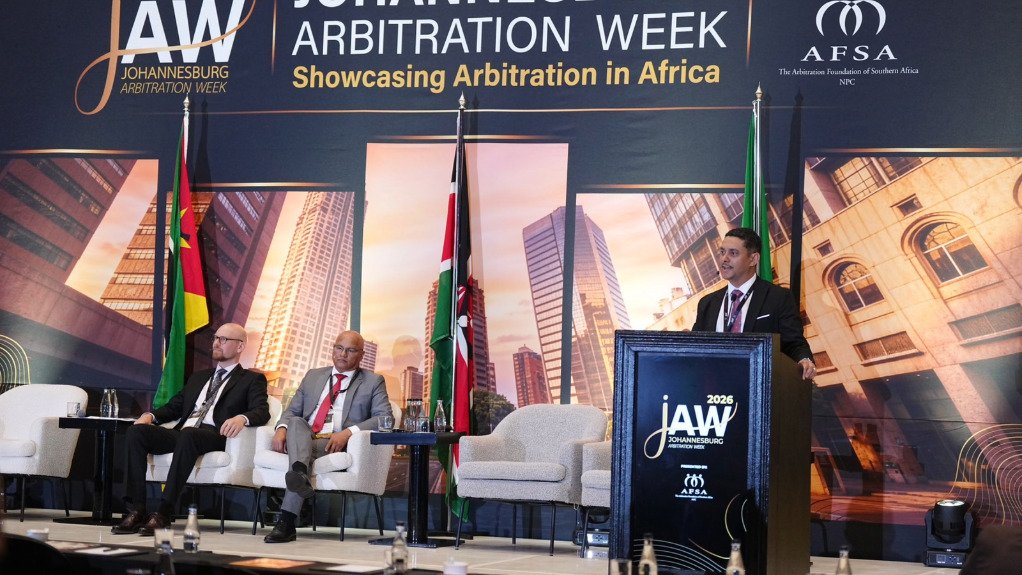
This was the central message provided during a session, titled, ‘BRICS, AfCFTA and the Fading Rules-Based Order: What This Means for Arbitration’, held at the Johannesburg Arbitration Week, at the Sandton Convention Centre, on May 5.
This session was moderated by law firm Cliffe Dekker Hofmeyr director and industrial, manufacturing and trader sector head Jackwell Feris and the panellists included Cliffe Dekker Hofmeyr CEO and director Brent Williams, law firms BCDM Law senior partner Bruno Barata, Dahui Lawyers partner Arthur Ma and Askari Legal partner Stanislav Karandasov.
Against a backdrop of rising geopolitical tensions, sanctions and weakening multilateral institutions such as intergovernmental organisation the World Trade Organisation, the panel argued that arbitration is increasingly becoming more important.
However, they noted that arbitration’s role is shifting from a neutral, rules-driven mechanism to one increasingly shaped by political realities and strategic considerations.
“This session is not about the collapse of the rules-based order. It is about understanding what it has become, and what that means for every single practitioner,” Feris said.
Feris also highlighted challenges attributed to the weaponisation of tariffs, the paralysis of global institutions, ongoing conflicts testing international law, and the rise of “lawfare”, which used legal systems to delegitimise opponents through bodies such as the International Court of Justice. Together, he said, these trends were reshaping how contracts were drafted, how disputes were managed and where arbitration was seated.
In this evolving landscape, the panellists highlighted the emergence of BRICS-Plus as a platform for alternative legal and economic cooperation, sharing that while efforts to harmonise arbitration frameworks across its now expanded membership remain ongoing, progress was uneven owing to the bloc’s diversity.
China’s growing prominence in this space was also highlighted, particularly following reforms that align its arbitration framework more closely with international standards, with Ma noting that as China opened its markets further to African exports, there could be a surge in cross-border transactions and disputes.
This development comes at an opportune time given the Chinese government’s recent decision to implement a zero-tariff policy for 53 African countries, including South Africa.
“I see that as great news. Once tariff barriers are removed, a huge amount of imports will occur and with transactions come disputes,” Ma said.
Meanwhile, Karandasov noted that Russian parties were increasingly turning to jurisdictions perceived as neutral as a way of bypassing traditional European seats amid the reality of sanctions redrawing the global arbitration map. This, he said, reflected a broader shift in which enforceability, political alignment and institutional independence were becoming central to arbitration strategy.
For Africa, Williams said, the current geopolitical shifts presented both an opportunity and a challenge in that the African Continental Free Trade Area (AfCFTA) had the potential to transform intra-African trade, but cautioned that its success depended heavily on the availability of credible, accessible dispute resolution mechanisms, and this was something the continent was still working to consolidate.
Speaking to Engineering News & Mining Weekly on the sidelines of the event, dispute resolution authority the Arbitration Foundation of Southern Africa (AFSA) CEO Andile Nikani framed Johannesburg Arbitration Week as part of a broader effort to reposition Africa within the global arbitration ecosystem.
“These events do for arbitral centres what little else can, as they solidify their relevance in international dispute resolution. They say to the world that this is who we are and this is what we’re capable of doing,” he said.
Nikani also stressed that visibility was critical, given that a significant portion of disputes involving African parties were still resolved outside of Africa, in arbitration centres such as London, in the UK or Paris, in France. He argued that building confidence in African institutions was essential to reversing that trend and retaining value within regional economies.
South Africa, he noted, was well-positioned, with a strong legal framework underpinned by its adoption of international arbitration standards and longstanding participation in global enforcement regimes such as the International Arbitration Act and the New York Convention.
Looking ahead, AFSA was pursuing a regional strategy aligned with African economic integration goals, including partnerships to establish arbitration centres across the continent. At the same time, technological innovation, particularly the use of AI, was beginning to reshape how disputes were managed, though Nikani was clear about its limits.
“AI should assist, not replace. It can help you work faster and cleaner, but it cannot substitute the judgment and responsibility of an arbitrator.”
As global trade realigns and legal norms continue to fragment, the panellists and Nikani agreed that arbitration was entering a more complex, politically attuned era, and for Africa, the challenge was not only to adapt to these changes, but to seize the moment by building institutions that were not just participants in the global system, but credible alternatives within it.
Article Enquiry
Email Article
Save Article
Feedback
To advertise email advertising@creamermedia.co.za or click here
Research Reports

Projects
Latest Multimedia

Latest News

Showroom
As one of South Africa's leading manufacturers, Bell Equipment distributes and exports its wide range of heavy equipment globally to mining,...
VISIT SHOWROOM
Rittal is a world leading provider of top-quality integrated systems for enclosures, power distribution, climate control, IT infrastructure and...
VISIT SHOWROOM

Press Office
Announcements
What's On
Subscribe to improve your user experience...
Option 1 (equivalent of R125 a month):
Receive a weekly copy of Creamer Media's Engineering News & Mining Weekly magazine
(print copy for those in South Africa and e-magazine for those outside of South Africa)
Receive daily email newsletters
Access to full search results
Access archive of magazine back copies
Access to Projects in Progress
Access to ONE Research Report of your choice in PDF format
Option 2 (equivalent of R375 a month):
All benefits from Option 1
PLUS
Access to Creamer Media's Research Channel Africa for ALL Research Reports, in PDF format, on various industrial and mining sectors
including Electricity; Water; Energy Transition; Hydrogen; Roads, Rail and Ports; Coal; Gold; Platinum; Battery Metals; etc.
Already a subscriber?
Forgotten your password?
Receive weekly copy of Creamer Media's Engineering News & Mining Weekly magazine (print copy for those in South Africa and e-magazine for those outside of South Africa)
➕
Recieve daily email newsletters
➕
Access to full search results
➕
Access archive of magazine back copies
➕
Access to Projects in Progress
➕
Access to ONE Research Report of your choice in PDF format
RESEARCH CHANNEL AFRICA
R4500 (equivalent of R375 a month)
SUBSCRIBEAll benefits from Option 1
➕
Access to Creamer Media's Research Channel Africa for ALL Research Reports on various industrial and mining sectors, in PDF format, including on:
Electricity
➕
Water
➕
Energy Transition
➕
Hydrogen
➕
Roads, Rail and Ports
➕
Coal
➕
Gold
➕
Platinum
➕
Battery Metals
➕
etc.
Receive all benefits from Option 1 or Option 2 delivered to numerous people at your company
➕
Multiple User names and Passwords for simultaneous log-ins
➕
Intranet integration access to all in your organisation