Data sovereignty, connectivity drive satellite interest


CONNECTIVITY SOVEREIGNTY Public–private partnerships are emerging as potential solution to deliver a sovereign satellite


Although the role of satellites in ensuring sovereign ownership of data while boosting rural connectivity is gaining traction amid increasing information and connectivity security concerns, governments must critically assess their satellite goals and long-term feasibility, says satellite operator Avanti Communications CEO Kyle Whitehill.
Satellite development and operation was initially prioritised through State-owned companies to facilitate communication with ships and airplanes.
However, connectivity has since evolved from being State-owned and controlled to being dominated by mobile network operators, aligned with the appeal of peer-to-peer, total- access communication, with the technological developments of phones further boosting the importance of reliable connectivity.
As a result, mobile network operators’ rapid growth left governments struggling to keep pace with the capabilities of mobile, fixed and satellite technologies, says Whitehill.
He posits that many Africa countries have not prioritised satellite development and ownership, as they presume that sufficient commercial satellite capacity exists and, therefore, precludes the need to develop their own.
However, the ongoing wars in Ukraine and Iran have raised concerns about the reliability and stability of commercial satellites.
“When Iran was attacked, the country lacked the communication infrastructure to match its physical military assets, and raised urgent concerns about network jamming,” Whitehill says.
This prompted various governments to evaluate what connectivity sovereignty entails and how to deliver it.
Nigeria has made significant progress in how it approaches satellite capabilities. State-owned satellite company NigComSat is viewed as a strategic asset for defence, economic development and rural connectivity, while government’s prioritising data sovereignty by having ownership of infrastructure keeps data in-country and secure.
Concerns about satellites and connectivity emerged about 15 years ago, and have been elevated of late, and with NigComSat’s NigComSat-1R communication satellite approaching its end-of-life, Nigeria is evaluating how it can leverage next-generation satellite capabilities.
However, Whitehill adds that African governments often struggle to justify multimillion- dollar investments in satellites amid more immediate national concerns.
As a result, public–private partnerships (PPPs) are emerging as potential solutions, often comprising a country, a funder and a satellite operator collaborating to deliver a sovereign satellite.
For example, the Democratic Republic of Congo (DRC) is in a partnership with private satellite operator Monacosat to launch a sovereign communications satellite, funded through a partner bank.
Whitehill notes that reaching an agreement with the DRC government and financiers took considerable time, while building the satellite itself will take about four to six years, amounting to about a decade from project inception to launch and service entry.
Nonetheless, given the scale and cost of launching and operating satellites, PPPs ensure that technical and operational aspects are managed by specialists, thereby increasing the probability of the project’s success.
Whitehill says governments often justify satellite investment with rural development goals, such as connectivity, particularly for schools, clinics and remote communities, as these goals resonate with citizens.
However, as satellites can provide a range of services, including broadcast media and broadband, he encourages governments to articulate what they would like to achieve and subsequently evaluate the goal’s practicality from a funding, action and planning perspective.
Whitehill also urges governments to view satellites as a sovereignty tool that ensures data “stays in the country”, which helps prevent attacks on data and data infrastructure.
Feasible Growth
Launching a satellite is a complex process, and established satellite companies have developed their expertise over many decades.
Satellites need to be sufficiently durable to withstand launch and subsequently function until they reach the end of their expected life of about 15 to 20 years, adds Whitehill.
Given these barriers, he encourages governments to approach satellite development and capacity-building gradually using an approach similar to that of Türkiye.
He explains that the country historically bought satellites from major international manufacturers, but gradually began to manufacture satellite components about ten years ago, culminating in the launch of its first domestically built and developed Türksat 5A in 2024.
Connectivity
From the company’s inception, Avanti’s founders were driven by the goal to “connect unconnected people in Africa”, says Whitehill, adding that about 75% of the company’s coverage and capacity are above sub–Saharan Africa.
It is unlikely that mobile and fixed networks will reach the entirety of rural and remote communities, as mobile and fixed network operators typically resist extending their coverage to these regions because it is costly and not profitable, which, in turn, further demonstrates the need for satellite connectivity.
However, Whitehill notes Avanti has experienced difficulty in funding rural roll-out, resulting in its goal stalling over the past decade, and while substantial funding exists outside Africa to invest in healthcare, education and security infrastructure, it is difficult to access and deploy that funding.
Ultimately, achieving this goal requires coordinated efforts from all stakeholders, including government and service providers, with “the whole ecosystem” needing to commit, Whitehill concludes.
Article Enquiry
Email Article
Save Article
Feedback
To advertise email advertising@creamermedia.co.za or click here
Research Reports

Projects

Latest Multimedia


Latest News

Showroom

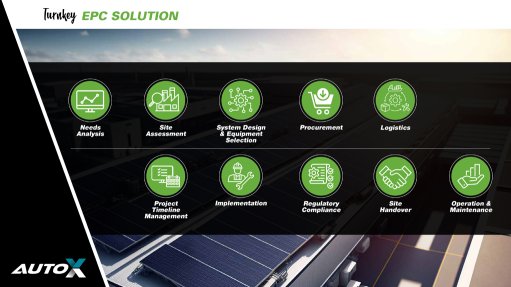
Rentech provides renewable energy products and services to the local and selected African markets. Supplying inverters, lithium and lead-acid...
VISIT SHOWROOM



Press Office
Announcements
What's On
Subscribe to improve your user experience...
Option 1 (equivalent of R125 a month):
Receive a weekly copy of Creamer Media's Engineering News & Mining Weekly magazine
(print copy for those in South Africa and e-magazine for those outside of South Africa)
Receive daily email newsletters
Access to full search results
Access archive of magazine back copies
Access to Projects in Progress
Access to ONE Research Report of your choice in PDF format
Option 2 (equivalent of R375 a month):
All benefits from Option 1
PLUS
Access to Creamer Media's Research Channel Africa for ALL Research Reports, in PDF format, on various industrial and mining sectors
including Electricity; Water; Energy Transition; Hydrogen; Roads, Rail and Ports; Coal; Gold; Platinum; Battery Metals; etc.
Already a subscriber?
Forgotten your password?
Receive weekly copy of Creamer Media's Engineering News & Mining Weekly magazine (print copy for those in South Africa and e-magazine for those outside of South Africa)
➕
Recieve daily email newsletters
➕
Access to full search results
➕
Access archive of magazine back copies
➕
Access to Projects in Progress
➕
Access to ONE Research Report of your choice in PDF format
RESEARCH CHANNEL AFRICA
R4500 (equivalent of R375 a month)
SUBSCRIBEAll benefits from Option 1
➕
Access to Creamer Media's Research Channel Africa for ALL Research Reports on various industrial and mining sectors, in PDF format, including on:
Electricity
➕
Water
➕
Energy Transition
➕
Hydrogen
➕
Roads, Rail and Ports
➕
Coal
➕
Gold
➕
Platinum
➕
Battery Metals
➕
etc.
Receive all benefits from Option 1 or Option 2 delivered to numerous people at your company
➕
Multiple User names and Passwords for simultaneous log-ins
➕
Intranet integration access to all in your organisation