Can resource nationalism lead to value-adding partnerships in Africa’s critical minerals sector?





The role of governments in supply chains has become quite topical of late, especially amid the bold moves made by the US to take national ownership of supply chains. In Africa, resource nationalism is a divisive term – for investors, it is seen as a risk and, conversely, as a means for legitimate government participation by academics – says independent policy institute Chatham House Critical Minerals Initiative director Christopher Vandome.
He was facilitating a panel discussion at the 2026 Investing in African Mining Indaba in Cape Town earlier this year on whether resource nationalism is paving the way for equitable global partnerships in critical minerals supply chains.
Mining major Rio Tinto government relations head for Africa Samuel Gahigi said there is no one-size-fits-all approach to having national ownership within a corporate structure.
“But, in general, what’s important for the business is that the government ensure that their interests are aligned, and that they define the type of equity they want, considering also the interests of the other investors.
“It is also important to have a dialogue with government that has a clear vision,” added Gahigi, using the co-development of the $20-billion Simandou iron-ore project in Guinea as an example.
“This project has been in the pipeline for over 20 years, but it took a transition in Guinea in 2021 to really accelerate the development of Simandou in a way that is quite creative and inspirational.
“There is a continuity and stability of investment that matters to the State. The State has also articulated its vision, which was to ensure that the partnership and co-development derisked every investor’s stake.”
Rio Tinto is involved in the Simandou project through a joint venture with Chinese industrial partners and the Winning Consortium Simandou. Gahigi shared that this is an interesting model, because besides the issue of equity, a multi-user, multi-purpose rail and port has been built, unlocking other opportunities for Guinea around agriculture and infrastructure development. This is in addition to the opportunities being unlocked by the Liberty Corridor, which plans to connect Kon Kweni in Guinea via rail to the new deep-water port in Didia, Liberia.
Human capital development is another important aspect of the Simandou project pushed by the Guinean government. By 2050, the World Bank expects there to be an additional 500-million young people entering Africa’s workforce.
Therefore, Gahigi highlighted that building human capital is critical, praising the Guinean government’s decision to pre-emptively allocate a portion of the royalties from the Simandou project to invest in the development of the Simandou Academy.
This forms part of the government’s Simandou 2040 economic programme, initiated to leverage the development of the Simandou iron-ore deposit with the aim of transitioning the country from a raw materials exporter into a regional industrial, energy and logistics hub. The academy aims to foster local human capital to meet government’s goal of creating 450 000 jobs by 2040.
Gahigi also underscored the gains to be had from driving local content given the volume of investment propelling local entrepreneurship in a project of Simandou’s scale.
Tax as an Instrument for Resource Nationalism
With African countries moving towards resource nationalism, Minerals Council South Africa acting chief economist Bongani Motsa questioned whether tax is the right instrument to use, or whether governments need to put in place an enabling policy and regulatory environment.
“Unless the taxes are advanced or earmarked, then there is a case for government to basically use taxes as an instrument for resource nationalism. The Resource Nationalism Index [by Maplecroft] has shown that there is an increase in the number of countries that use tax as an instrument to protect their resources. And that is very interesting.”
He said there is convergence towards more protection.
“In the context of South Africa, the revenues that are collected by National Treasury, the policy-makers, those revenues are never earmarked, and that is a challenge when you think about, for example, an industry that is suffering from high electricity tariffs. As the Minerals Council, we would like any revenues collected, from an export tax or export restrictions, to be ringfenced to promote the global competitiveness of the ferro alloys industry.”
Local Content through Resource Nationalism
World Bank senior mining specialist Dr Martin Lokanc commented that ten years ago the hot topic at Mining Indaba was local content policy.
“Now, I think that linking it to resource nationalism maybe isn’t too much of an issue, if everybody wants it and understands why it’s happening. Some companies such as Rio Tinto have adapted their way of working to incorporate it in their operating philosophy. But having said that, not all companies do that, and so countries do want to have effective local content policies.”
Lokanc suggested that every government start by asking what their objective with local content is. While some may think that is a silly question, he said there is quite a spectrum of what this looks like.
“There’s the equity. Is it just about ownership? Do you want just national ownership of companies that are suppliers? Is it about actual value addition happening in countries – taking several semi-manufactured products and maybe manufacturing semi-manufactured products and then assembling into a final product? And what’s the priority? Would you trade one off for the other?”
He provided a scenario where a company involved in the full value chain has a foreign owner, with thousands of jobs created to supply a mine.
“Would you want that company to qualify under local content policy, or not, because they’re not locally owned? Or would you rather move to 100% local ownership, but no value addition in country? You’d be surprised at how many countries don’t really reflect on that, because, depending on how you want to position this, it really unpacks the magnitude of the problem.”
Focusing on ownership or equity is the simple way, making it the company’s problem, explained Lokanc, adding that the reality is the creation of middle-man or catalogue companies that offer a catalogue of imports to which they add a markup.
He warned that if a country had a company involved in the full value chain, it would no longer qualify.
“Therefore, you could displace an industry. That’s an unintended consequence. If you want to focus on the full value chain, then you need to look at the ecosystem in which these companies operate.”
Policy is one thing, but what the World Bank has seen drive success across the continent and the world is a partnership approach. While the mining industry plays a big role in articulating the demand for the types of products and services needed, and opening those opportunities up, government also plays a big role, explained Lokanc.
Access to finance is a recurring theme in the Southern African Development Community region.
“Interest rates are incredibly high. I’ve seen companies that do vendor financing just so that they can get the local content and support companies. That’s part of the partnership. Sometimes these local companies are competing unfairly with imported goods because there’s an import tariff or an exemption to an import tariff given to mining companies, whereas if local companies need to import components to assemble, they’ll pay the tariffs,” elaborated Lokanc.
He emphasised that sometimes special economic zones (SEZs) have a perverse impact.
“They may be put in place for a specific, high-tech industry, but sometimes you find companies setting up shop in those SEZs and benefiting from the tax breaks and the local small and medium-sized enterprises can’t access the same tax break, creating an unfair advantage.”
If a country goes the equity route, Lokanc said it might be fast initially – as it is easy to pass the regulation because they have not had to deal with the ecosystem – but it will come up afterwards. Countries will either have to make amendments, ignore where companies are non-compliant or put fines in place where “companies tried their best to comply but just simply couldn’t, because there was just no possible way”.
The point of departure for Chatham House associate fellow Sheila Khama is that any government that views mineral, oil and gas resources as a political tool already has destroyed value.
“My sense is that the policies that don’t work are the ones that are really responding to national political sentiment rather than looking genuinely at the economics, first of the particular deposit, but then also on the value chain of the particular mineral.”
She said this is the distinction that is necessary, and any policies that do not have that informed point of departure are bound to fail.
“Martin has already illustrated a case in point where we say we will like local content, but what we really mean is that we’re creating an elite class of ‘tenderpreneurs’, as opposed to entrepreneurs. This is dangerous, because what you then do is disincentivise those that might come into the country and genuinely invest, because you create the wrong kind of partnership structure.”
Khama argued that this breeds a class of elite that has no vested interest in actually investing their own capital and uses government policy as de facto, a form of capital, which is to say an input which has no economic output.
This is a major challenge, she stressed, stating that resource nationalism works when the State recognises its privileged position as the owner of the asset and asks, in the big scheme of things, what is the biggest role government can play to unleash this value, as well as what is the biggest role that the private sector can play, striking a partnership. In this partnership the State should not relinquish its responsibility to ensure that the asset is developed, but should also not impose itself and, thereby, undermine the value that investors might bring on board.
“This second distinction is important, but it’s not just important for economic reasons, but also because governments will not be able to regulate mining if they don’t understand mining. Some of the equity positions that governments take allow them to be inside of the industry, understanding the pain, the downside and the upside of mining,” elaborates Khama.
This knowledge can be used to inform and introduce policy reforms that respond to the real situations instead of assumptions. Khama is convinced of the value of very limited equity positions that nevertheless place government at the centre of managing and making decisions on mining projects, as it enables the transfer of knowledge that results in otherwise better-informed policy and regulatory environment.
Article Enquiry
Email Article
Save Article
Feedback
To advertise email advertising@creamermedia.co.za or click here
Research Reports
Projects

Latest Multimedia

Latest News
Showroom
The SAIMM started as a learned society in 1894 after the invention of the cyanide process that saved the South African gold mining industry of the...
VISIT SHOWROOM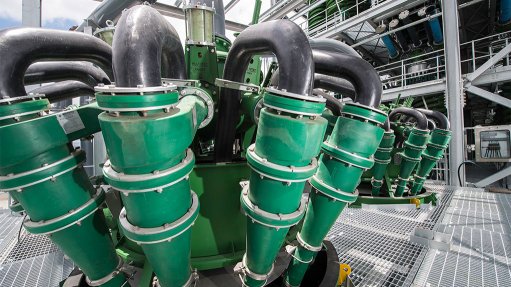
Multotec, recognised industry leaders in metallurgy and process engineering help mining houses across the world process minerals more efficiently,...
VISIT SHOWROOM

Announcements
What's On
Subscribe to improve your user experience...
Option 1 (equivalent of R125 a month):
Receive a weekly copy of Creamer Media's Engineering News & Mining Weekly magazine
(print copy for those in South Africa and e-magazine for those outside of South Africa)
Receive daily email newsletters
Access to full search results
Access archive of magazine back copies
Access to Projects in Progress
Access to ONE Research Report of your choice in PDF format
Option 2 (equivalent of R375 a month):
All benefits from Option 1
PLUS
Access to Creamer Media's Research Channel Africa for ALL Research Reports, in PDF format, on various industrial and mining sectors
including Electricity; Water; Energy Transition; Hydrogen; Roads, Rail and Ports; Coal; Gold; Platinum; Battery Metals; etc.
Already a subscriber?
Forgotten your password?
Receive weekly copy of Creamer Media's Engineering News & Mining Weekly magazine (print copy for those in South Africa and e-magazine for those outside of South Africa)
➕
Recieve daily email newsletters
➕
Access to full search results
➕
Access archive of magazine back copies
➕
Access to Projects in Progress
➕
Access to ONE Research Report of your choice in PDF format
RESEARCH CHANNEL AFRICA
R4500 (equivalent of R375 a month)
SUBSCRIBEAll benefits from Option 1
➕
Access to Creamer Media's Research Channel Africa for ALL Research Reports on various industrial and mining sectors, in PDF format, including on:
Electricity
➕
Water
➕
Energy Transition
➕
Hydrogen
➕
Roads, Rail and Ports
➕
Coal
➕
Gold
➕
Platinum
➕
Battery Metals
➕
etc.
Receive all benefits from Option 1 or Option 2 delivered to numerous people at your company
➕
Multiple User names and Passwords for simultaneous log-ins
➕
Intranet integration access to all in your organisation