



Technology can bolster workplace safety when paired with human accountability





Organisations in South Africa’s industries such as mining and infrastructure are increasingly adopting technology solutions to enhance workplace health, safety and security, and there is a clear need for these solutions to be pursued ethically and used to complement rather than replace human accountability and oversight.
This was highlighted by speakers in a Creamer Media webinar, ‘Health, Safety and Security’, held earlier this month.
South Africa’s laws require employers to provide a working environment that is safe and does not pose a risk to employee health, as far as reasonably practicable, noted law firm ENS Africa mine and occupational health and safety executive Tyla Foster.
This obligation is governed by two main pieces of legislation: the Occupational Health and Safety Act, and the Mine Health and Safety Act.
These laws impose general and specific obligations on employers, while allowing for a level of flexibility in the measures implemented to achieve a safe working environment, depending on the nature of the operation and risk profile of the company in question.
Employers can therefore explore the adoption of new technology solutions as part of their consideration of all available options, with the ultimate aim of ensuring the health and safety of employees and visitors to the premises or sites to the greatest extent possible, in line with the country’s regulations.
However, employers that choose to use modern technologies must be cognisant of legislation governing the processing of personal information and ensure that the use of such technologies does not infringe on workers’ legally protected rights.
“There is movement and growth for the employer to try these different things that might work for them, but in essence the employer always needs to make sure that whatever they do actually achieves that ultimate objective [of a safe working environment],” Foster emphasised.
She urged employers to exercise adequate control over these measures and implement sufficient oversight to ensure they function as intended.
Integrated productivity and safety solutions provider Probe Integrated Mining Technologies (IMT) is successfully deploying advanced technology sensors as part of its integrated productivity and safety solutions for the mining sector, in line with a strong regulatory drive to use real-time monitoring to ensure worker safety.
Probe IMT digital mining solutions product specialist Tsepiso Taole said continuous real-time monitoring supports the health and safety regulations and requirements highlighted by Foster by providing mines or employers with clear operational visibility.
Rather than relying on periodic and manual measurements, these technologies enable mines to identify risks as they develop, thereby preventing them from escalating into harmful incidents. Moreover, they provide reliable evidence to ensure that the workplace functions effectively.
Taole elaborated that the company’s intelligent sensors continuously monitor environmental conditions such as gas concentrations, airflow, ventilation performance and airborne pollutants.
“We aim to monitor continuously and alert immediately, respond faster and keep detailed records. . . Mines must know what workers are exposed to, what exposures there are within the workplace and measure all those exposures properly, and use the information to control risks that are identified.”
He highlighted that the data derived from the company’s sensors on its various technologies is intended to support compliance with health and safety regulations and enable a shift from a reactive to predictive approach to risk mitigation and management.
Support, Not Supersede
Consulting Engineers South Africa (Cesa) VP Jabulile Msiza stressed that digital tools do not replace accountability, but rather heighten it.
While technology can improve decision-making, accountability still rests with qualified professionals who interpret the data, validate the outputs and ensure that designs comply with safety standards and regulatory requirements.
“The increasing use of digital systems also creates higher expectations around proactive risk identification and predictive maintenance, real-time reporting and transparent oversight,” Msiza added.
Cesa believes that technology must be viewed as an enabling tool rather than a substitute for professional responsibility and that the industry has not reached a stage where there is overreliance on automated systems without adequate human oversight.
“While AI models and digital monitoring systems are being used, there’s still the oversight, and professional engineers will continue exercising independent judgement, ethical responsibility and rigorous quality assurance,” Msiza added.
Taole echoed that technology is not intended to replace accountability or qualified perspectives but is rather an enabling tool that can be used to make operations safer and promote zero harm.
Digital transformation, in many instances, strengthens accountability by improvingtraceability, documentation and visibility in decision-making processes, making it more difficult for failures, omissions and noncompliance to go unnoticed when projects aredigitally monitored and recorded in real time, Msiza explained.
Technology Awareness and Investment
Cesa is working to develop practice notes and guideline documents for members to highlight the advantages and risks of using AI and digital tools.
“We’ve got an entire portfolio that deals with technology and transformation and how wecan effectively and safely use AI to be more efficient, but still act professionally within thescope of our work,” Msiza said.
The practice notes are compiled by practitioners to assist members in managing risk, andthe notes provide guidelines on best practice in the field.
Cesa also hosts regular webinars to discuss the notes and update them, based onfeedback from members, with "considerable interest" having been shown by participants.
"Our members are very eager and very keen for industry standards and guidance in terms ofhow we can all move together in the same direction. There is great acceptance, there isgreat participation and a great eagerness to comply. As a Cesa member firm, you areabiding to our code of conduct that requires you to continually stay updated with the bestpractice,” Msiza highlighted.
Foster reiterated echoed this sentiment, calling on employers to stay abreast of developing technologies and to find ways of using them as part of measures to provide a health and safety management system.
While mining operations and other industries face cost pressures, introducing health and safety technologies should be regarded as a risk mitigation investment, and not an additional overhead, Taole said, warning that the cost of noncompliance faroutweighs the cost of investment.
Prioritising investment will result in a considerable reduction in injuries, fatalities and downtime, alongside improved compliance and reduced regulatory pressure, as well as increased production uptime and greater worker confidence and retention, as workers can expect a safer working environment.
Taole further advised mining companies to consider technologies that are scalable and adaptable to different mine layouts, systems that can integrate easily and are interoperable with existing systems or infrastructure, and those that lower total cost of ownership while increasing reliability and ease of maintenance.
Article Enquiry
Email Article
Save Article
Feedback
To advertise email advertising@creamermedia.co.za or click here
Research Reports

Projects

Latest Multimedia

Latest News

Showroom
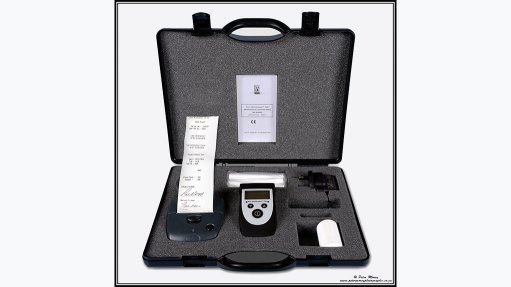
Developed to exceed the latest EN 15964 standards for police breathalysers proving that it will remain accurate and reliable for many years to come.
VISIT SHOWROOM
Occupational health services, mobile clinics, wellness campaigns, aviation.
VISIT SHOWROOM



Announcements
What's On
Subscribe to improve your user experience...
Option 1 (equivalent of R125 a month):
Receive a weekly copy of Creamer Media's Engineering News & Mining Weekly magazine
(print copy for those in South Africa and e-magazine for those outside of South Africa)
Receive daily email newsletters
Access to full search results
Access archive of magazine back copies
Access to Projects in Progress
Access to ONE Research Report of your choice in PDF format
Option 2 (equivalent of R375 a month):
All benefits from Option 1
PLUS
Access to Creamer Media's Research Channel Africa for ALL Research Reports, in PDF format, on various industrial and mining sectors
including Electricity; Water; Energy Transition; Hydrogen; Roads, Rail and Ports; Coal; Gold; Platinum; Battery Metals; etc.
Already a subscriber?
Forgotten your password?
Receive weekly copy of Creamer Media's Engineering News & Mining Weekly magazine (print copy for those in South Africa and e-magazine for those outside of South Africa)
➕
Recieve daily email newsletters
➕
Access to full search results
➕
Access archive of magazine back copies
➕
Access to Projects in Progress
➕
Access to ONE Research Report of your choice in PDF format
RESEARCH CHANNEL AFRICA
R4500 (equivalent of R375 a month)
SUBSCRIBEAll benefits from Option 1
➕
Access to Creamer Media's Research Channel Africa for ALL Research Reports on various industrial and mining sectors, in PDF format, including on:
Electricity
➕
Water
➕
Energy Transition
➕
Hydrogen
➕
Roads, Rail and Ports
➕
Coal
➕
Gold
➕
Platinum
➕
Battery Metals
➕
etc.
Receive all benefits from Option 1 or Option 2 delivered to numerous people at your company
➕
Multiple User names and Passwords for simultaneous log-ins
➕
Intranet integration access to all in your organisation
