Middle East crisis underlining relevance of supply strength of South Africa’s Omnia

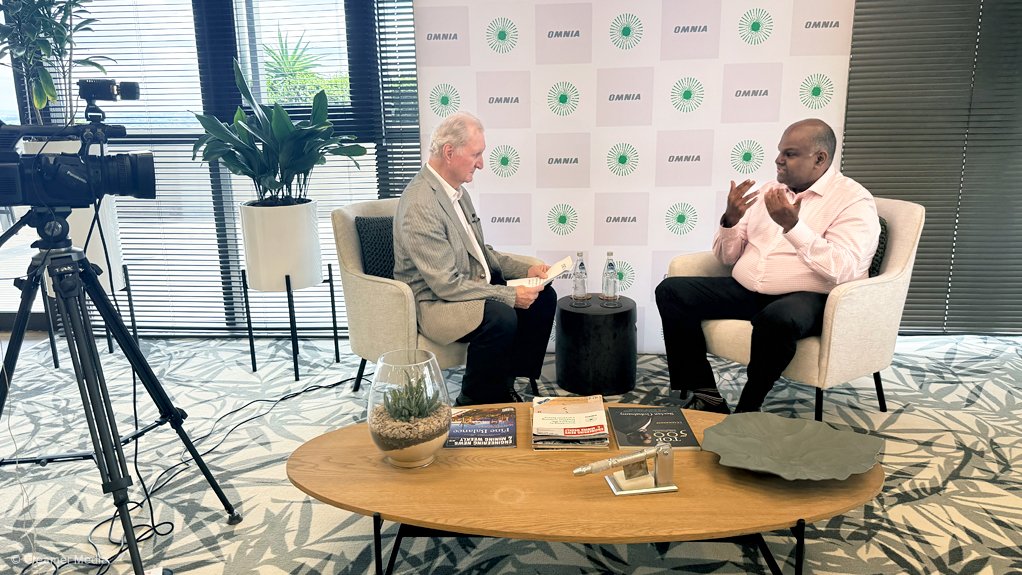
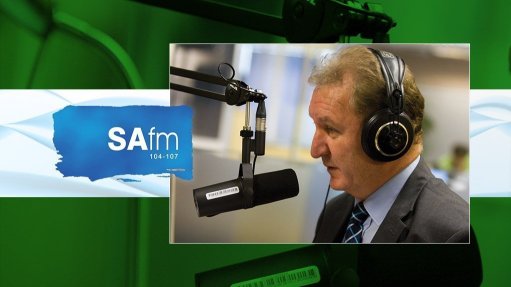
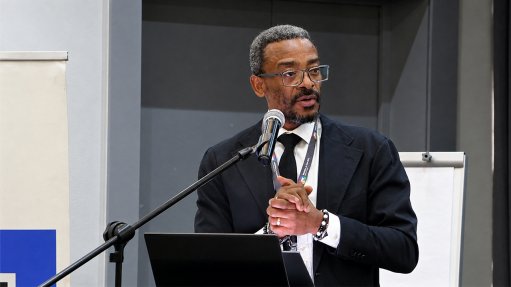
Omnia CEO Seelan Gobalsamy interviewed by Mining Weekly's Martin Creamer. Video: Darlene Creamer.
Omnia CEO Seelan Gobalsamy (right) being interviewed by Mining Weekly's Martin Creamer.
Photo by Creamer Media


JOHANNESBURG (miningweekly.com) – At this time of crisis in the Middle East, the supply chain strength of South Africa’s Omnia is of major relevance from mining and agriculture perspectives.
The Johannesburg Stock Exchange-listed Omnia has a strong grasp of ammonia-based emulsion and explosives inputs as well as key detonator capability, which adds value to mines by providing appropriate fragmentation and ensures that mines have the inputs to blast when they need them, which is so relevant amid what is being faced today – Middle East supply chain disruption.
On the agriculture front, Omnia is the largest producer of ammonia-based fertilisers in the Southern African Development Community (SADC).
“Our teams are very busy moving things around due to the situation in the Middle East, to make sure that our farmers and our mines have strong supply chains to allow them to plant and to blast,” Omnia CEO Seelan Gobalsamy highlighted in an interview with Engineering News & Mining Weekly in Johannesburg on Wednesday, March 25. (Also watch attached Creamer Media video.)
From an explosives and mining perspective, Omnia expresses the belief that it has the strongest supply chain of ammonia-based emulsion and explosives inputs and that its detonator capability and technology add value through appropriate fragmentation, and enable mines to blast and have the inputs to blast when needed – “and that’s so relevant in what the world is facing today, with the crisis in the Middle East”.
Omnia, which is strongly rooted in South Africa, has 200 of its own ammonia rail tankers that transport as well as an ammonia storage capability.
It is a 70-year-old business that began in agriculture, and over the years moved into explosives, and chemicals, and today finds itself making a profound difference in the mining and agriculture markets.
Over the last five years, Omnia’s mining explosives business has grown by 40% plus to the point of last year overtaking the agriculture business.
Omnia is a strong provider of food security and a deeply embedded provider of mining explosives across the African continent and across the world with operations in 23 countries.
“Our North Star is to be a very strong explosives provider across the world, not just in South Africa, and that's why we’re investing in detonator plants, emulsion plants across the world, with partners. Our strong underpin is a business with values and a business with strategies and products that are doing what is right for the environment, not just for our generation, so that when our kids, when our grandkids, when their kids and grandkids walk the earth, it can be a better place than what it was when we walked the earth. Food can be healthier, there can be fewer chemicals being used, less water being used, and overall, the environment and the earth being better,” Gobalsamy projected.
The company has a market capitalisation of just under R15-billion, zero debt and has been able to expand and recruit.
“We invest in a lot of young people. We hire 1% of our workforce a year as young graduates. We give them a job for a year, and then we expect them to find something in Omnia or elsewhere.
“A few years ago, we also decided to give everyone in our company shares. Everybody, no matter how senior or junior, got 300 shares, and we redid that programme a year later.
“Our belief is, if you do good, if you run a good business, the profit should follow. We've got a very noble purpose in enhancing life, and we believe everyone must share in that gain,” Gobalsamy opined.
“Omnia was started by two very entrepreneurial individuals. They started, initially trading lime, and eventually moved into fertiliser.
“If I walk through the generations, in 1980 the company listed on the Johannesburg Stock Exchange. Since then, the company has continued to build large plants and if I talk through some of those milestones, we have the largest nitric acid plants in the SADC, the most modern plants.
“We've got fertiliser granulation plants, the only ones in SADC, and we've got an incredible nitro phosphate plant, which takes phosphate rock and produces phos acid. It also produces calcium nitrate, which we use in the explosives industry.
“We've got about 70 rugby fields of these incredible plants that have been built in Sasolburg, thanks to our predecessors who invested and did that. We continue to do that.
“If I take it a bit further, we then bought BME, which is the mining business, and then Protea Chemicals, and then businesses across the world and made investments in businesses across the world.
“We've got a joint venture in Canada, a joint venture in Indonesia. We've got a great agri business in Brazil, a partnership in India, from an agri perspective, and our humates business in Australia. If we step a little bit further, we continue to expand on the African continent and today we can proudly say that we are a strong provider of food security and a deep, embedded provider of mining explosives across the African continent and in certain countries around the world.
“As we saw disruption and change happening, Omnia continued to invest in rail tankers. We have our own rail tankers that move ammonia around – 200 of them. We are one of the few companies in the country that does that. We also have storage capability, and we have the strongest supply chain in this region. That has kept us out of a situation of having to declare force majeure, even during the initial Russia/Ukraine issues, the issues with the Suez Canal, and now our teams are very busy moving things around due to the Middle East, to make sure that our farmers and our mines have strong, strong supply chains to allow them to plant and to blast.
“There were also some difficult times in 2018/19, the company had expanded a little bit faster than it should have, potentially, and we needed to do a rights issue. The balance sheet was stressed. We've made some changes. We changed capital allocation, and since then, the market cap has grown from circa R2-billion to just under R15-billion. We've been able to pay R35-billion worth of dividends back to shareholders. At half-year, the company had no debt,” Gobalsamy outlined to Engineering News & Mining Weekly.
Mining Weekly: What do you do in SADC particularly when it comes to your nutriology and agribio models?
Gobalsamy: In SADC, Omnia is the largest producer of ammonia-based fertilisers. We have a number of agronomists, folk on the ground who are with our growers and our farmers. Our focus is to ensure that our farmers are able to enhance their yield, use fewer inputs, less water, less nutrient, and get the highest yield for the hectares planted. We've got the technology that underpins that. We do half a million soil tests or samples. We've got large laboratories in Sasolburg, the largest in the southern hemisphere. We help our farmers all through the journey, from the soil to the crop to the harvest. As the crop is being grown, we’re able to take some of the leaf sap and accurately predict the quality of the crop. From a six-week apple plant, we can accurately predict how crunchy that apple will be and tell farmers that this apple will land in a tin of canned fruit, or it will be exported to a First World country and land in a fancy hotel in London or Munich or Dubai. Our job is to make sure farmers have what they need to plant – the technology and the science and the research that backs it, and that's broadly what we do in SADC. We call that the nutriology model, a word our team coined. Then, if we move to what we do outside of the African continent, we have a fabulous business in Australia. It's a biologicals business, so it's a completely green business. What it does is extract humate from the earth and kelp from the sea. It blends that into various products, coating products, liquid products and speciality products. We then distribute that all across the world. If I simplify it, in essence, it enhances the efficacy of fertiliser, sunlight and water on the crop. It allows the crop to be healthier from a root structure perspective, and it allows the crop to produce more by using fewer chemicals. It's a completely green product, so there's high demand for this product, and this we distribute into India, China, Brazil, the US, the EU, the Middle East, Australia itself, and into Africa.
Let's swing to what Omnia does in the business of chemicals.
Chemicals underpin our agriculture and our mining businesses. We've got all the inputs that are used for fertilisers, speciality fertilisers, and then explosives. But we also have a traditional chemicals business, where we use the strength of our supply chain to buy in larger parcels, benefit from lower logistics cost, and then provide those input chemicals into the SADC marketplace. We also have a water-care business. We're holding that business for sale. Our core is agriculture and mining and, over the last five years, our mining explosives business has grown by 40% plus CAGR. Last year, it was actually bigger than our agriculture business and our chemicals business is by far the smaller component, probably accounting for under 5% of our products.
You spoke about having a completely green business in Australia. How green are you in South Africa and do you intend to generate any more renewable electricity?
Let me firstly say that the world is in a strange place at the moment. Our friends in the US have made the whole world rethink ESG, rethink diversity, and rethink climate and the environment. We’re completely committed to doing things better for the environment, reducing our CO2 emissions, helping our farmers use less water, less chemicals, helping our mines use less water and less chemicals. Firstly, you are pointing to our solar farm that we've built in Sasolburg. We continue to expand that. We're building another 5 MW. If you ever see a picture of it, you'll be fascinated to see what it looks like. (Also see attached video.)But added to that, we recycle water. We've got a reverse osmosis plant where we do 180 megaliters of water through that. We obviously use solar in our factory. But what we also do, which is very unique, is our emulsion into the mining explosives industry has used oil in it. Most other emulsions across the world use clean new oil. We have created a sort of secondary supply chain and gathered the used oil from mines and other industrial businesses. We clean and process that, and then we create an emulsion explosive product from it. If you think of honey, the emulsions of our competitors who use new clean oil look like a honey, and if you think of what our emulsion looks like, it looks like a Marmite. It's dark and, in essence, the used oil is better for the environment, it's more cost effective, it creates secondary industries and employment, and it's a lot more stable. Where you've got reactive ground in difficult areas, such as copper mines in the Northern Cape and in Zambia, the used oil is a huge positive for mines. When the ground is reactive, it's more stable, and it provides a benefit to mines. So, ESG, doing better for the environment and using fewer chemicals, is something that's built into our daily strategies, in our capital allocation, where we invest, and it's the way we do things and I think that's something we can be very proud about.
HYDROGEN PEROXIDE EXPLOSIVES
Mining Weekly can report that in October, Omnia’s BME and Sweden-based explosives company Hypex Bio Explosives Technology (Hypex Bio) advanced their partnership beyond Canada by initiating an infrastructure and product development programme for the SADC market.
BME and Hypex Bio are introducing hydrogen peroxide explosives in the SADC mining market for various blasting applications, including opencast mining operations.
Hydrogen peroxide products emphasise BME’s standing in the supply of sustainable bulk emulsions as hydrogen peroxide-based explosives decompose into water and oxygen.
The partnership between BME and Hypex Bio is expected to play a significant role in the shift to more sustainable mining in SADC, while also establishing the standard for next-generation blasting in the region.
Article Enquiry
Email Article
Save Article
Feedback
To advertise email advertising@creamermedia.co.za or click here
Projects
Latest Multimedia
Latest News
Showroom
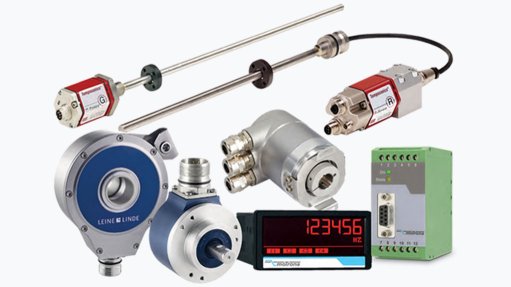
ATI systems comprises five divisions: electrical assemblies, drives and controls, feedback sensors, enclosures, and strip guiding.
VISIT SHOWROOM
EIMS is an independent specialised environmental consulting firm offering the full spectrum of environmental management services across all sectors...
VISIT SHOWROOM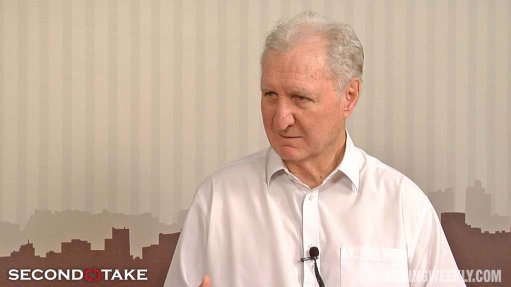
Announcements
What's On
Subscribe to improve your user experience...
Option 1 (equivalent of R125 a month):
Receive a weekly copy of Creamer Media's Engineering News & Mining Weekly magazine
(print copy for those in South Africa and e-magazine for those outside of South Africa)
Receive daily email newsletters
Access to full search results
Access archive of magazine back copies
Access to Projects in Progress
Access to ONE Research Report of your choice in PDF format
Option 2 (equivalent of R375 a month):
All benefits from Option 1
PLUS
Access to Creamer Media's Research Channel Africa for ALL Research Reports, in PDF format, on various industrial and mining sectors
including Electricity; Water; Energy Transition; Hydrogen; Roads, Rail and Ports; Coal; Gold; Platinum; Battery Metals; etc.
Already a subscriber?
Forgotten your password?
Receive weekly copy of Creamer Media's Engineering News & Mining Weekly magazine (print copy for those in South Africa and e-magazine for those outside of South Africa)
➕
Recieve daily email newsletters
➕
Access to full search results
➕
Access archive of magazine back copies
➕
Access to Projects in Progress
➕
Access to ONE Research Report of your choice in PDF format
RESEARCH CHANNEL AFRICA
R4500 (equivalent of R375 a month)
SUBSCRIBEAll benefits from Option 1
➕
Access to Creamer Media's Research Channel Africa for ALL Research Reports on various industrial and mining sectors, in PDF format, including on:
Electricity
➕
Water
➕
Energy Transition
➕
Hydrogen
➕
Roads, Rail and Ports
➕
Coal
➕
Gold
➕
Platinum
➕
Battery Metals
➕
etc.
Receive all benefits from Option 1 or Option 2 delivered to numerous people at your company
➕
Multiple User names and Passwords for simultaneous log-ins
➕
Intranet integration access to all in your organisation