Laxity has left South Africans without the energy jobs platinum can provide

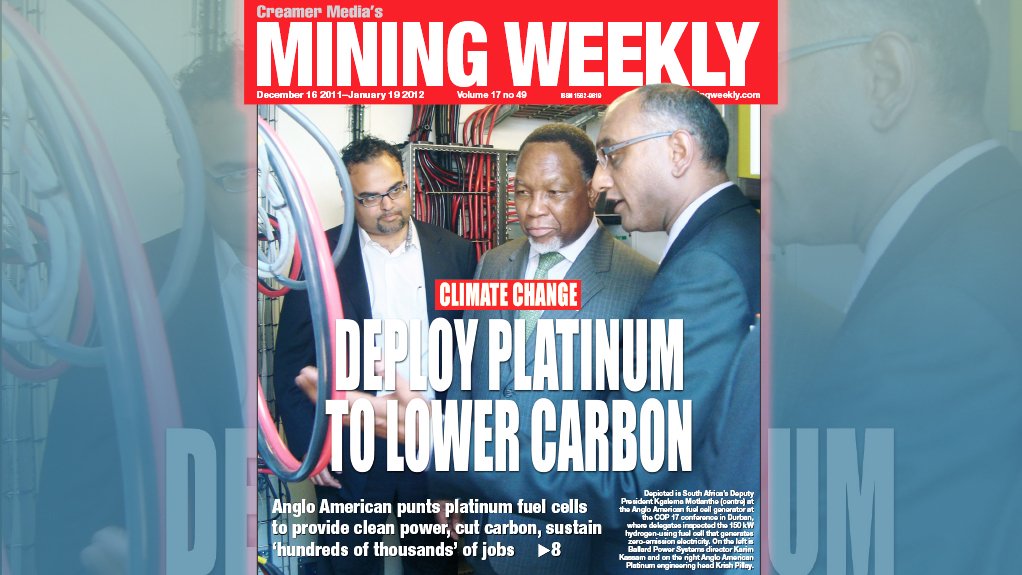
Fashback to 16 December 2011's thrust by then Anglo American CEO Cynthia Carroll to put platinum-based hydrogen on the map.
Photo by Creamer Media


JOHANNESBURG (miningweekly.com) – The date was December 2011. The place was Durban. The occasion was an Anglo American media conference led by then Anglo CEO Cynthia Carroll. The topic was the opportunity to use Anglo’s platinum group metals (PGMs) to generate clean hydrogen power and sustain hundreds of thousands of South African jobs.
A roundtable media discussion provided access to many PGM executives to answer questions. Carroll drew on an abundance of old and new research to champion the fuel cell’s cause at a function held by the World Business Council on Sustainable Development and the International Chamber of Commerce for the presidency of the United Nations climate change convention’s seventeenth Conference of the Parties (COP 17).
Carroll declared the window of opportunity to be “wide open" for South Africa to create "hundreds of thousands of new jobs" and simultaneously obtain a source of clean zero-emission electricity.
The think-tank put to work was the UK’s Carbon Trust, which found that hydrogen fuel cells had the potential to drive development of a new industrial sector in South Africa and provide South Africa with the opportunity to become a major global green economy participant.
At the same time, Ballard of Canada, in the presence of South Africa’s then Deputy President Kgalema Motlanthe, demonstrated the enabling power of PGMs in electrolysers and fuel cells.
Providing special insight was Anglo Platinum engineering head Krish Pillay, who outlined how PGM-catalysed electrolysers are able to provide the green hydrogen that PGM-catalysed fuel cells turn into clean electricity, and providing oversight was Ballard Power Systems director Karrim Kassam.
Between then and now, Ballard has been using zero-emission PGMs-catalysed proton exchange membrane (PEM) fuel cells to power buses, trucks, trains, ships, stationary power plants, and you name it.
It has been living out its vision of delivering PGMs-based hydrogen fuel cell power to help to shield Mother Earth from the vagaries of climate change to major effect and with great aplomb.
Since COP 17, Mining Weekly has been receiving 15 years of input from Ballard. In fact, its latest communique highlights the use of its hydrogen PEM fuel cells – and when you see PEM, see PGM – for the many data centres that are springing up across the globe because of their zero-emission advantage.
Also since then, Anglo Platinum has become Valterra Platinum, which reported in its 2025 annual reporting suite received by Mining Weekly on Friday, March 27 that “the hydrogen economy is set to be a broad demand sector with strong growth, despite some short-term challenges, as global policy becomes more supportive”.
Shortly before that, on Thursday, March 1, Sibanye-Stillwater CEO Dr Richard Stewart told the PGMs Industry Day: “I’m actually pretty bullish on hydrogen” and at the same event Implats CEO Nico Muller added: “I think hydrogen’s got the inside track.”
But can you imagine where South Africa would be now if the country had just kept pace with Ballard.
Even at that 2011 stage, many were convinced PEM presented a compelling case to power South Africa’s large taxi fleet with hydrogen in place of petrol.
Many were recalling how fuel-from-coal company Sasol began by having one Sasol pump at petrol stations owned by other companies.
Former Sasol CEO Peter Cox used to say to Engineering News & Mining Weekly that Sasol could repeat that by starting with a single hydrogen pump at each petrol station and get hydrogen mobility going.
Now, Northam Platinum CEO Paul Dunne, who is also president of Minerals Council South Africa, is drawing strong attention to China using Sasol-type grey hydrogen to power thousands of hydrogen trucks in China as an interim measure. The five-year target is to then advance to green hydrogen.
With the Middle East crisis lifting fuel prices to dizzy heights, many in South Africa are again pointing to the hydrogen opportunity.
Toyota tells Mining Weekly that modifying its taxis to run on hydrogen would result in the loss of one seat, which taxi owners are not keen to see happening.
But where there’s a will, there’s a way, particularly amid the taxi business facing serious fuel price rise.
“To secure the future of PGM demand, we must actively create it – through partnership, shared investment, and a wide portfolio approach that continually brings new applications into the pipeline,” Valterra Platinum, headed by CEO Craig Miller outlined in a recent LinkedIn post.
“By combining Johnson Matthey's industrial technology leadership with a growing base of aligned partner capital, we can fast-track impactful new PGM applications and help shape the demand of tomorrow,” the Valterra note added.
South Africa can and should work with all countries and companies with hydrogen know-how to revert to an energy that it does not have to import.
Wonderful news is that South Africa’s Isondo Precious Metals and ET Energies are taking steps to accelerate the commercialisation of high-performance PGMs-based PEM electrolyser technology up to full electrolyser production with other partners across the globe, while supporting the objectives of South Africa’s Hydrogen Society Roadmap, which emphasises industrialisation, localisation of hydrogen technologies, and value addition to the country’s critical mineral resources.
Internationally, the news of hydrogen electrolysis and fuel cell mobility is flowing rapidly. Just a few newsbreaks in Mining Weekly’s tray right now are:
- The Dutch Parliament has voted to transpose EU rules for green hydrogen-based fuels for transport.
- China has advanced towards a new national guideline that reduces hydrogen prices to around €3/kg for fuel cell electric trucks, buses and heavy equipment in particular.
- Brussels has approved Italy’s plans to spend €6-billion on green hydrogen production for transport and industrial applications, supporting a targeted 200 000 t of green hydrogen production a year.
- Germany has unveiled a €6-billion funding package for 2026 to supercharge green hydrogen production, back carbon capture projects, and uplift hydrogen infrastructure across the country. The Federal Ministry for Economic Affairs and Energy, led by Minister Katherina Reiche, introduced the Hydrogen Acceleration Act to slice through red tape and fast-track everything from electrolysers to pipelines. These moves are all about locking in Germany’s 2045 climate neutrality goal and cementing its role as Europe’s hydrogen hub.
- Finland has attracted an estimated 60 green hydrogen projects over the last few of years, with one 20 MW facility in Harjavalta now in operation.
- Green hydrogen company Greenzo Energy India and Lord’s Mark Industries of India are collectively developing 60 MW of green hydrogen projects in the state of Uttar Pradesh.
- Hydrexia has secured an order to provide Toyota Australia with a number of relocatable hydrogen refuelling stations to support hydrogen-powered fuel cell electric vehicles in the Australian market.
- UK electrolyser manufacturer ITM Power Plc has obtained approval to proceed with a 20 MW hydrogen project.
- Hydrogen fuel cell powered cruise ship Viking Libra, just launched, has a 6 MW system with zero emissions.
- Toyota has announced that it will begin mass-producing 5 MW PEM electrolysers in the 2029 fiscal year.
- Bosch Hydrogen Energy has opened an electrolysis facility at Farmington Hills in the US, which involves PEM electrolysis.
- A new liquid hydrogen facility of Air Products in the Port of Rotterdam, now 65% complete, is on the way towards becoming Europe’s largest liquid hydrogen production facility when operational in 2027.
- Japan has launched a commercial engine capable of generating electricity by using a 30% hydrogen blend developed collaboratively by Kawasaki Heavy Industry.
- A hydrogen plasma smelting reduction process for sustainable steel production from iron-ore, uses molecular, atomic and ionised hydrogen as reducing agents. A pilot plant with a capacity of 100 kg of iron-ore per trial has been built in Austria.
- Toyota wants to become the third shareholder in Cellcentric, the German startup founded in 2021, which is jointly owned by Daimler Truck and Volvo. The four companies signed a non-binding memorandum of understanding to collaborate on fuel cell technology, with Toyota bringing three decades of experience to the table.
And the list will go on….
Article Enquiry
Email Article
Save Article
Feedback
To advertise email advertising@creamermedia.co.za or click here
Research Reports
Projects
Latest Multimedia

Latest News
Showroom

North Ridge Pumps is an independent manufacturer of pumps. We have a proven track record for product support and customer service throughout the...
VISIT SHOWROOM
As a reticulator, Egoli Gas provides natural gas to homes and businesses via underground pipes.
VISIT SHOWROOM
Announcements
What's On
Subscribe to improve your user experience...
Option 1 (equivalent of R125 a month):
Receive a weekly copy of Creamer Media's Engineering News & Mining Weekly magazine
(print copy for those in South Africa and e-magazine for those outside of South Africa)
Receive daily email newsletters
Access to full search results
Access archive of magazine back copies
Access to Projects in Progress
Access to ONE Research Report of your choice in PDF format
Option 2 (equivalent of R375 a month):
All benefits from Option 1
PLUS
Access to Creamer Media's Research Channel Africa for ALL Research Reports, in PDF format, on various industrial and mining sectors
including Electricity; Water; Energy Transition; Hydrogen; Roads, Rail and Ports; Coal; Gold; Platinum; Battery Metals; etc.
Already a subscriber?
Forgotten your password?
Receive weekly copy of Creamer Media's Engineering News & Mining Weekly magazine (print copy for those in South Africa and e-magazine for those outside of South Africa)
➕
Recieve daily email newsletters
➕
Access to full search results
➕
Access archive of magazine back copies
➕
Access to Projects in Progress
➕
Access to ONE Research Report of your choice in PDF format
RESEARCH CHANNEL AFRICA
R4500 (equivalent of R375 a month)
SUBSCRIBEAll benefits from Option 1
➕
Access to Creamer Media's Research Channel Africa for ALL Research Reports on various industrial and mining sectors, in PDF format, including on:
Electricity
➕
Water
➕
Energy Transition
➕
Hydrogen
➕
Roads, Rail and Ports
➕
Coal
➕
Gold
➕
Platinum
➕
Battery Metals
➕
etc.
Receive all benefits from Option 1 or Option 2 delivered to numerous people at your company
➕
Multiple User names and Passwords for simultaneous log-ins
➕
Intranet integration access to all in your organisation