Give South Africa’s manganese mines a good logistics future right now – don’t wait

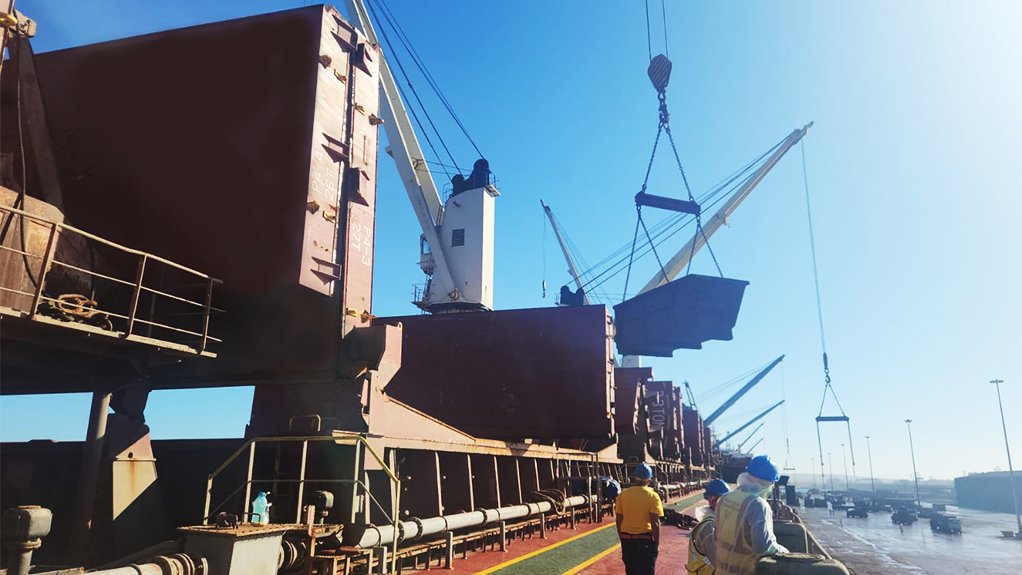
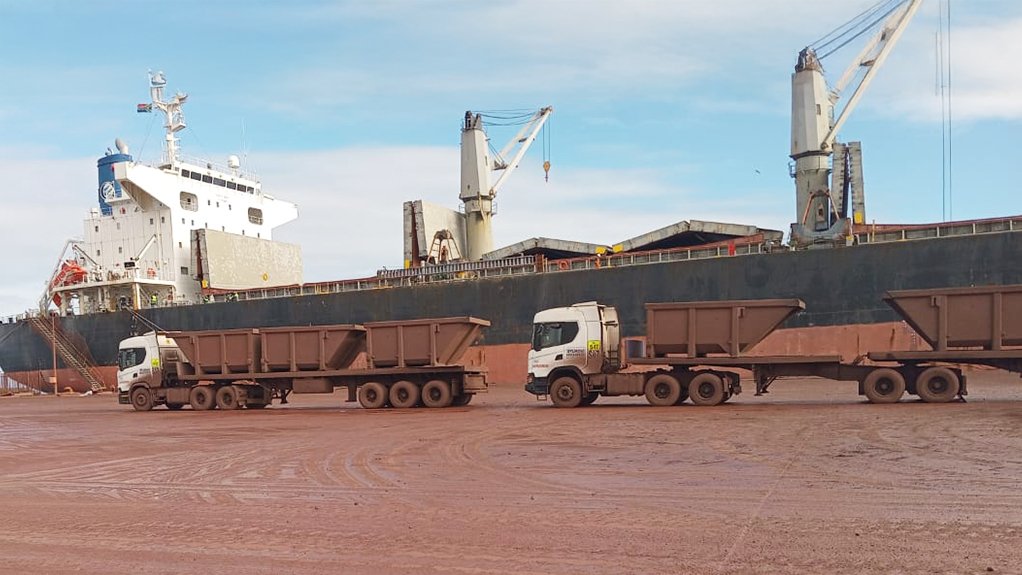
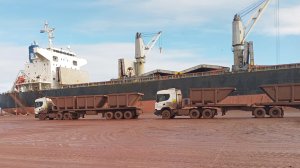


JOHANNESBURG (miningweekly.com) – Without compromising the positions of any stakeholders or the credibility of the process, a way must be found to fast-track a good logistical future for South Africa’s very important manganese mining industry.
Needed is a very clear position that is bankable and then South Africa Incorporated must move forward – and do so very fast to avoid South Africa losing out to its nimbler global manganese competitors.
Reducing logistics costs is an absolute must. It doesn’t make sense for any country with such a valuable manganese endowment to be rendered uncompetitive by State-operated logistics.
State-owned Transnet and the State-run Department of Transport (DoT) must look at the issues very carefully because unless manganese mining makes the necessary structural changes to ensure that the next phase of investment can stay close to what it has been in the past, South Africa is, without doubt, heading towards a cul-de-sac – and as the window of opportunity closes, nobody will know where to go next.
What must be top of mind is giving the people of South Africa the best return.
While Kalahari has a wonderful manganese endowment, its 1 000 km distance from any port turns South Africa’s manganese mining into a mining-plus-logistics business, with the mining in private hands and the logistics in generally much slower public hands.
As things stand, manganese mining won’t always be of the lower-cost opencast variety; investment decisions about going underground at higher cost will have to be taken progressively from now on.
With logistics already making up a third of the cost of manganese mining, the private sector is intent on collaborating with the public sector to ensure that those costs are slashed.
While people will probably still buy South African manganese even if our competitors overtake us, an evacuation network as costly as the existing one will result in money to fund even future stay-in-business growth becoming increasingly scarce and greenfield growth will be shelved.
Currently, there are two transport corridors, one to Saldanha and the other to Gqeberha.
The Saldanha corridor is a good one, despite having port constraints that must be sorted out. Why this corridor is a good bulk-commodity transport route is because very little else travels along it.
But considerably more complicated is the rail line to Gqeberha, which is a multi-freight line with passenger and automotive connections at different points. The manganese ore is also made to wend its way through a four-terminal port complex that pushes up costs.
Several manganese mining companies tell Mining Weekly that the way to go is for 12-million tonnes a year to go down the Saldanha line, and a matching 12-million tonnes to go through Gqeberha – and not the current 16 t to Gqeberha and 8 t to Saldanha.
Fortunately, a lot of research is available for the DoT and Transnet to use for the good of South Africa’s economy.
THE RESPONSES OF MANGANESE MAJORS
Will South Africa’s ore advantage translate into long‑term competitiveness?
South Africa holds one of the world’s most substantial manganese ore resource endowments. Yet the limits confronting the sector today are increasingly defined not by what lies underground, but by what happens above it.
The country remains one of the world’s most important sources of manganese ore, with the Kalahari Basin estimated to hold between 75% and 80% of global geological resources. This has supported decades of mining activity and export earnings. However, this natural advantage is under growing pressure for reasons largely unrelated to resource scarcity.
The central challenge is whether manganese ore can be moved to global markets competitively and reliably, year after year, in an increasingly contested global environment. Competing jurisdictions are not standing still. They are investing aggressively in infrastructure and logistics systems that lower costs, improve reliability, and attract capital. South Africa’s success will depend less on the size of its orebody, and more on the effectiveness of the systems built around it. The threat of the diminishing competitiveness of South African manganese ore exports is the key concern that has been expressed by the producers that Mining Weekly have spoken to.
What are the risks of the full economic value of South Africa’s manganese ore not being realised?
The fundamental question facing the country is whether it is — and will continue to be — able to sustainably extract the full economic value of its manganese ore resources for national benefit.
Possessing large ore reserves is only the starting point. The binding constraint is the ability to move that ore to global customers at a cost and level of reliability that justifies sustained mining investment. When logistics inefficiencies drive up costs or undermine predictability, a growing gap emerges between the theoretical value of the resource and the foreign currency, tax revenue and employment actually realised. That gap is not dramatic, but it is persistent — and over time, deeply damaging.
The consequences extend far beyond mining companies. Manganese ore exporters support employment across the value chain, particularly in the Northern Cape, where unemployment stands at approximately 27%. They contribute meaningfully to tax revenues at a time when the fiscus has limited capacity to absorb further losses. When export volumes are constrained by congested rail lines and ports, and underperforming rail systems and ports rather than by market demand — those revenues are lost permanently.
To what extent are cost, distance and system performance defining competitiveness?
In South Africa’s manganese sector, mining and logistics are inseparable.
The main orebodies lie approximately 1 000 km from export terminals, making transport cost and system efficiency decisive determinants of competitiveness — yet largely outside the control of individual producers. As a rough approximation, the cost of producing and delivering a tonne of manganese ore consists of three roughly equal components: mining, inland transport to port, and onward delivery to end‑users, primarily in Asia, India and Europe.
In a market where global demand is relatively stable and producers compete within a tight cost band, logistics performance becomes the decisive factor. South Africa’s freight rail operates on narrow gauge, with lower axle loads and challenging gradients. This requires more wagons, more energy and higher operating costs to transport the same volume as many global peers. Over time, these structural disadvantages shape production decisions, deter new investment and influence the long‑term trajectory of the sector.
These challenges are amplified by the current institutional architecture. Rail and port infrastructure are managed as distinct components rather than as integrated export corridors — unlike in many competing bulk commodity jurisdictions. The result is frequent misalignment between rail and port capacities and throughputs, creating delays, congestion and unnecessarily high costs (e.g. vessel demurrage etc) at system interfaces.
The slow and opaque implementation of rail reform has further compounded these issues. While the DoT published requests for information in March 2025 for manganese ore export corridors, and Transnet has identified the planned Ngqura Manganese Export Terminal as a flagship project in its 2025 Annual Report, no requests for proposals have yet been issued. This lack of follow‑through remains a significant concern for producers.
Why is intent-to-execution urgency so crucial?
Timing now matters as much as design. South Africa’s competitors are investing in infrastructure today, and the window to consolidate the country’s manganese ore advantage is not indefinite. The cost of inaction is already visible. When supply disruptions occur elsewhere in the global market, South Africa is frequently unable to respond quickly, not due to lack of demand, but because logistics capacity is constrained by excessive logistics costs and tariffs.
Smaller and emerging producers are disproportionately affected. Their sustainable growth depends directly on access to affordable, reliable rail and port capacity.
The growing reliance on road haulage underscores the problem. While road transport offers flexibility, it is an inferior long‑term solution for bulk commodities over distances of this scale. It is more expensive, damages public infrastructure, compromises road safety and introduces operational uncertainty. An operational and cost efficient, high‑capacity, integrated rail and port export corridor is not a preference — it is a prerequisite for sustained competitiveness of SA Inc.
Delays in large infrastructure projects also carry hidden costs. Prolonged procurement processes force both the public and private sectors to retain advisory teams for extended periods, while each year of delay risks higher construction and financing costs. At the same time, the economy continues to bear the cost of exporting lower volumes at structurally higher unit costs.
Why is alignment so crucial?
What the manganese ore industry requires is a logistics system managed as an integrated corridor, rather than a collection of separately run assets.
A well‑functioning and capacitated port cannot compensate for a rail network that cannot deliver, and rail investment is wasted if the port it feeds lacks capacity and performance. Planning, investment and operations must be aligned across the system to achieve a genuinely lower cost per tonne.
These challenges cannot be resolved by the private sector alone, nor by Transnet acting in isolation. Rail lines and port terminals are State‑owned assets, and decisions regarding their capacity, maintenance and prioritisation ultimately rest with government and its agencies.
What industry can bring is capital, operational and business expertise, skills and modernisation — together with a clear commercial case for improving throughput on manganese export corridors. For this to translate into investment, the institutional framework must be stable, bankable and credible. Procurement processes must be genuinely independent, with a clear separation between policy‑makers, asset owners, operators and bidders.
Capital of this scale is not deployed based on good intentions. It flows when rules are clear, counterparties are reliable, and returns are defensible. South Africa has struggled on all three fronts in recent years, and this history continues to weigh on investment decisions. Restoring confidence will require consistent, visible execution — not messaging.
CONCLUSION
South Africa’s manganese ore endowment is a significant national asset. But resources alone do not determine outcomes. What ultimately matters is the sustainable operational and cost effectiveness of the systems built around them.
If logistics constraints persist, the country risks leaving much of the value of its manganese ore resources unrealised. The ore exists. The demand exists. Converting those facts into sustained export volumes, jobs and revenue requires an export system — and an institutional environment — capable of delivery.
This is a solvable problem. But it is not a patient one.
The countries that will shape the next phase of the global manganese ore market are making infrastructure decisions now. South Africa must be among them.
Article Enquiry
Email Article
Save Article
Feedback
To advertise email advertising@creamermedia.co.za or click here
Research Reports
Projects

Latest Multimedia

Latest News
Showroom
The SAIMM started as a learned society in 1894 after the invention of the cyanide process that saved the South African gold mining industry of the...
VISIT SHOWROOM
Multotec, recognised industry leaders in metallurgy and process engineering help mining houses across the world process minerals more efficiently,...
VISIT SHOWROOM
Announcements
What's On
Subscribe to improve your user experience...
Option 1 (equivalent of R125 a month):
Receive a weekly copy of Creamer Media's Engineering News & Mining Weekly magazine
(print copy for those in South Africa and e-magazine for those outside of South Africa)
Receive daily email newsletters
Access to full search results
Access archive of magazine back copies
Access to Projects in Progress
Access to ONE Research Report of your choice in PDF format
Option 2 (equivalent of R375 a month):
All benefits from Option 1
PLUS
Access to Creamer Media's Research Channel Africa for ALL Research Reports, in PDF format, on various industrial and mining sectors
including Electricity; Water; Energy Transition; Hydrogen; Roads, Rail and Ports; Coal; Gold; Platinum; Battery Metals; etc.
Already a subscriber?
Forgotten your password?
Receive weekly copy of Creamer Media's Engineering News & Mining Weekly magazine (print copy for those in South Africa and e-magazine for those outside of South Africa)
➕
Recieve daily email newsletters
➕
Access to full search results
➕
Access archive of magazine back copies
➕
Access to Projects in Progress
➕
Access to ONE Research Report of your choice in PDF format
RESEARCH CHANNEL AFRICA
R4500 (equivalent of R375 a month)
SUBSCRIBEAll benefits from Option 1
➕
Access to Creamer Media's Research Channel Africa for ALL Research Reports on various industrial and mining sectors, in PDF format, including on:
Electricity
➕
Water
➕
Energy Transition
➕
Hydrogen
➕
Roads, Rail and Ports
➕
Coal
➕
Gold
➕
Platinum
➕
Battery Metals
➕
etc.
Receive all benefits from Option 1 or Option 2 delivered to numerous people at your company
➕
Multiple User names and Passwords for simultaneous log-ins
➕
Intranet integration access to all in your organisation