Companies urged to embed ESG into everyday practices

An expert panel discusses how businesses are embedding ESG within their value chains.


As South African companies face increasing pressure to demonstrate responsible sourcing, reduce carbon intensity and ensure greater transparency across their operations and supplier networks, companies are urged to embed environmental, social and governance (ESG) practices in their everyday operations.
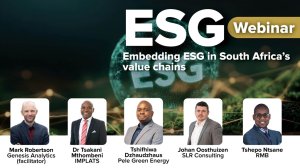
Facilitated by Genesis shared value and impact practice principal Mark Robertson, panellists participating in Creamer Media’s ESG webinar, held on June 17, explored how businesses are integrating ESG considerations into procurement, production and operational systems, as well as turning sustainability ambitions into measurable action.
Joining Robertson on the panel were Implats sustainable development executive Dr Tsakani Mthombeni, Pele Green Energy environmental and social specialist Tshifhiwa Dzhaudzhau, SLR Consulting associate director Johan Oosthuizen and Rand Merchant Bank (RMB) sustainable finance and ESG advisory transactor Tshepo Ntsane.
“ESG is not a one-off initiative; it must be embedded throughout the lifecycle of the project if it's going to deliver a meaningful and sustainable outcome. It cannot be a one-off implementation,” said Dzhaudzhau.
He stated that social impact could not be treated as a compliance exercise, but must be designed to create lasting value and to allow communities to participate in the project over the long term.
He argued that implementing community ownership structures, local procurement opportunities and skills development allowed communities to be included in the project.
He also emphasised the importance of implementation and of measuring outcomes, rather than measuring activities.
Dzhaudzhau argued that meaningful social impact, therefore, came from consistency, transparency and long-term participation throughout a project’s lifecycle, rather than isolated intervention.
From a mining perspective, Mthombeni explained that markets and stakeholders were now seeking more intentionality with regard to ESG, as well as for greater integration into business strategies.
He noted that mining companies were now focusing on material risks for the business and stakeholders, including communities.
Hence, he highlighted the importance of understanding the materiality, applicability and relevance of ESG systems to the business environment.
Moreover, Ntsane noted that ESG integration made corporates bankable.
He explained that banks look favourably on companies that are seen to be implementing their ESG strategies, noting that corporates are embracing this position.
He thus highlighted the importance for companies of understanding where they were in terms of ESG risks and opportunities by conducting a materiality assessment.
Once a company’s baseline and footprint was understood, Ntsane said, it could then set forward-looking targets which could be supplemented with initiatives and projects to help the company achieve those targets.
“The principle that underlines ESG is actually the double materiality,” he said, noting that it was important for a company to understand how its activities impacted on the environment and society, as well as understand how sustainability-related risks and opportunities affected the organisation.
Meanwhile, Oosthuizen said local businesses often underestimated their exposure to Scope 3 risks, noting that companies treated value chains as risk amplifiers.
He noted that businesses often implemented management systems that did not extend beyond the boundary of the business, thereby also limiting opportunity.
Hence, he highlighted the importance of understanding and managing Scope 3 emissions, driven by a legislative push and the shift from responsibility being placed solely on suppliers, to companies also being curators of impact.
Oosthuizen emphasised the opportunity to generate impact through supply chains, leveraging local suppliers and enabling women-led entrepreneurs, for example.
Hence, he said, while risk was a driving factor, there were also opportunities to start using value chains as impact multipliers.
“What we put in is double, triple, quadruple what we get out, so if you put the right emphasis into your supply chains or value chains, you're going to get four times, five times as much out of it. It's really about understanding the leverage you have and then using that for positive impact down the line.”
Article Enquiry
Email Article
Save Article
Feedback
To advertise email advertising@creamermedia.co.za or click here
Research Reports

Projects

Latest Multimedia


Latest News

Showroom

The Steel Tube Export Association of South Africa was established to develop sustainable, internationally competitive carbon steel tube and pipe...
VISIT SHOWROOM
At Airshrink - CiP, we surpass customer expectations with innovative MV and LV cable accessories, including heat shrink joints, terminations,...
VISIT SHOWROOM


Announcements
What's On
Subscribe to improve your user experience...
Option 1 (equivalent of R125 a month):
Receive a weekly copy of Creamer Media's Engineering News & Mining Weekly magazine
(print copy for those in South Africa and e-magazine for those outside of South Africa)
Receive daily email newsletters
Access to full search results
Access archive of magazine back copies
Access to Projects in Progress
Access to ONE Research Report of your choice in PDF format
Option 2 (equivalent of R375 a month):
All benefits from Option 1
PLUS
Access to Creamer Media's Research Channel Africa for ALL Research Reports, in PDF format, on various industrial and mining sectors
including Electricity; Water; Energy Transition; Hydrogen; Roads, Rail and Ports; Coal; Gold; Platinum; Battery Metals; etc.
Already a subscriber?
Forgotten your password?
Receive weekly copy of Creamer Media's Engineering News & Mining Weekly magazine (print copy for those in South Africa and e-magazine for those outside of South Africa)
➕
Recieve daily email newsletters
➕
Access to full search results
➕
Access archive of magazine back copies
➕
Access to Projects in Progress
➕
Access to ONE Research Report of your choice in PDF format
RESEARCH CHANNEL AFRICA
R4500 (equivalent of R375 a month)
SUBSCRIBEAll benefits from Option 1
➕
Access to Creamer Media's Research Channel Africa for ALL Research Reports on various industrial and mining sectors, in PDF format, including on:
Electricity
➕
Water
➕
Energy Transition
➕
Hydrogen
➕
Roads, Rail and Ports
➕
Coal
➕
Gold
➕
Platinum
➕
Battery Metals
➕
etc.
Receive all benefits from Option 1 or Option 2 delivered to numerous people at your company
➕
Multiple User names and Passwords for simultaneous log-ins
➕
Intranet integration access to all in your organisation